A first Marrakech visit usually begins with a list: the square, the minaret, the palaces, the madrasa, the blue garden. The list is not the problem. The problem is that Marrakech is a walled medieval city layered over itself, and a list says nothing about which of these places share a day, which need morning tickets bought in advance, and which sit on the far side of town near the airport runway.
This is a grouping guide, not a timed itinerary. It draws on the Unlocked Marrakech collection, the published walking track, UNESCO’s medina entry, and the Mrrakc heritage map checked in September 2026. It promises no walking durations, queue lengths, or access guarantees; check those for your own dates.
Start with the walls, not the map
Five of the seven Landmarks sit inside the medina UNESCO inscribed in 1985. Two sit outside the walls entirely: Jardin Majorelle to the northwest in the modern city, and the Menara Gardens to the west, on the airport side. That single fact splits the collection into three planning groups before anything else is decided.
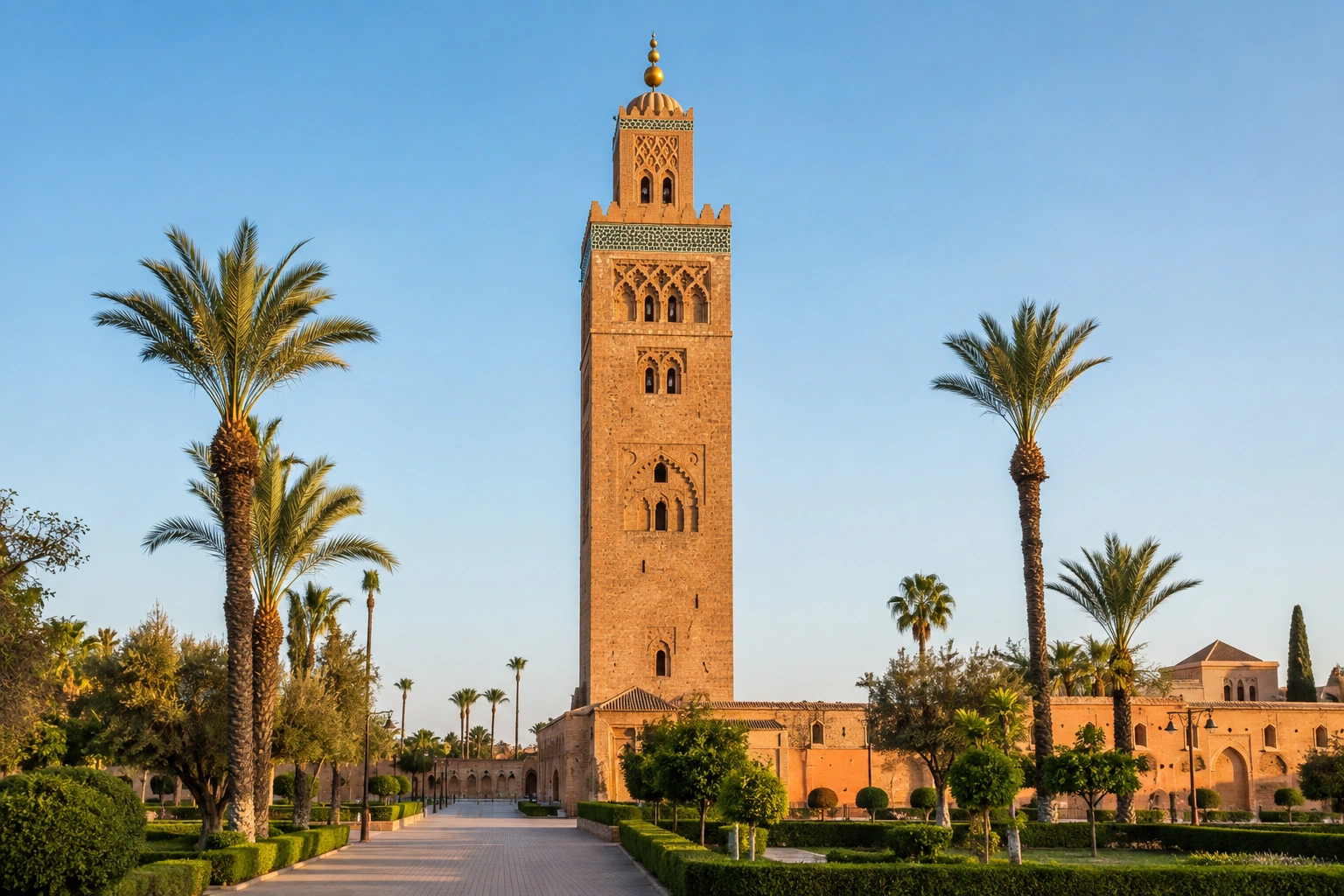
Inside the walls, use the Koutoubia minaret as your reference point — UNESCO’s entry calls the 77-metre tower the city’s essential monument, and it is visible across the medina. The southern quarter, the Kasbah side, holds Jemaa el-Fnaa, the Koutoubia, Bahia Palace, and El Badi Palace. The northern quarter holds the Ben Youssef Madrasa and the densest souk network.
The distances sound trivial. Computed straight from the catalog’s own coordinates, Jemaa el-Fnaa to the Koutoubia is about 400 metres, Jemaa to Bahia about 800, Bahia to El Badi about 500, and Jemaa to the Madrasa under 800. Trust none of it for scheduling. The medina guarantees that the walked distance exceeds the straight line, and the stretch between the Madrasa and the square runs through the souk crush, where your pace is set by the crowd, not by your plan.
One strong day: the southern four
Jemaa el-Fnaa, the Koutoubia, Bahia Palace, and El Badi Palace combine into one day with a natural arc: open square first while your attention is fresh, minaret and gardens second, then the two palaces as the light flattens.
Incorrect example: treating Bahia and El Badi as duplicates and skipping one to save time. They are the same period’s opposite answers — Bahia is a working palace of courtyards and painted cedar built for grand viziers, El Badi is a deliberately monumental ruin stripped of its marble after the Saadian dynasty fell. One shows you the finish, the other shows you the bones.
Correct principle: if you must drop one, decide by light and by shade, not by category. Bahia’s covered courtyards hold up at noon; El Badi’s open sunken gardens earn their keep in low evening light. Our heat-day plan builds an entire schedule around that difference.
One budget note, honestly dated: per the Mrrakc map checked in September 2026, Bahia, El Badi, and the nearby Saadian Tombs all list the same foreign-adult admission on the Moroccan Ministry of Culture’s ticket portal. Admission terms change; verify on the portal’s own ticket pages before you budget the day.
The northern morning: Madrasa and souks
The Ben Youssef Madrasa rewards a morning built around it rather than a bolt-on. Its official site lists daily hours from 9 a.m. to 7 p.m., with tickets purchased at the entrance — the site notes online ticketing has been unavailable, so do not count on buying ahead. The fourteenth-century building was rebuilt under the Saadians in 1564–1565, and its courtyard pool, zellige, carved cedar, and stucco reward slow attention.
Pair it with the souk network that stretches south toward the square — Souk Semmarine is the main artery — and the surrounding small museums the Mrrakc map catalogues in the same quarter. That gives the morning one decorated interior anchor, one working-craft district, and no cross-town transfers. The medina photo guide, squares, minarets, and courtyards, covers the picture-making decisions in this quarter.
Majorelle on its own half-day
Jardin Majorelle is the collection’s one hard ticketing constraint, and it is worth planning around. The garden’s official site states plainly that tickets can only be purchased online through its own platform, warns against unauthorized resellers, and lists daily hours of 8 a.m. to 6:30 p.m. with last entry at 6 p.m. The adjacent Yves Saint Laurent museum is a separate museum with its own admission.
The garden sits roughly two kilometres northwest of Jemaa el-Fnaa, outside the medina’s logic entirely. Incorrect example: wedging Majorelle between the palaces and the evening square because the map line looks short. Correct principle: give it its own half-day, ideally the morning slot the official hours are built for, and pair it with the modern city’s cafés and galleries rather than with medina stops. The Majorelle and Menara photo guide compares it with the city’s other garden.
Menara: where the map says airport
The Menara Gardens sit west of the walls on the airport side, about three kilometres from the square by straight line. That placement is the planning insight: Menara is the natural stop for a last evening or a departure morning, when you are already heading west and want one wide, quiet, open-air landmark instead of a final medina push.
What you get is an Almohad-era water basin, an olive grove, and a green-roofed pavilion facing the Atlas mountains across open ground. Recent visitor reports disagree about which parts of the site charge admission and how much, so treat any published fee as stale until you are at the gate. The pavilion-and-basin composition is an evening frame; see the after-dark guide for how the day’s last light fits the schedule.
The published track, and when to follow it
If you want the one-day version, the published Blue to Medina Gold track already strings five of the seven in a workable order — Majorelle, the Madrasa, the square, the Koutoubia, Bahia — beginning at the garden’s morning opening. Follow it if one long day is your trip; split by quarter as above if you have two or three days and want the palaces at their best light. A composed four beats a rushed five, and a composed five beats a heroic seven.
What the app needs from each day
Unlocked verifies presence, one Landmark at a time. Open the Landmark, choose Unlock while inside its supported area, and confirm success before moving on. The check at the square does not cover the Koutoubia or Bahia; each place keeps its own record. Your first GPS unlock grants one welcome credit once per account, and every verified unlock stays attached for later.
Two Marrakech-specific notes. First, the Koutoubia: no mosque entry is involved, because non-Muslim visitors cannot enter the mosque; the supported area covers the public square-and-garden side, which is where the minaret is actually seen. Second, the Madrasa is its own Landmark — confirm that one in the app, not the neighbouring mosque. The first-visit photo habits apply to all seven: do the visit, confirm the unlock, put the phone away.
And if you have not yet decided between Marrakech and Rabat at all, read the Morocco decision guide first; this page is for the trip you have already booked. For the day-to-day texture — the square’s changeover, the evening schedule, the noon heat — continue with the Jemaa el-Fnaa visit plan, the after-dark guide, and the heat-day plan.
Useful details
Frequently asked questions
Can I visit all seven Marrakech Landmarks in one day?
Straight-line distances between the medina landmarks are short — under a kilometre from Jemaa el-Fnaa to the Ben Youssef Madrasa — but the medina does not walk in straight lines, and two of the seven, Jardin Majorelle and the Menara Gardens, sit entirely outside the walls. Five stops is already a full day; this guide promises no walking durations, and you should recheck current access for your own dates.
Does Unlocked plan my route between the Landmarks?
No. The app verifies presence inside each Landmark's supported arrival area. The published Marrakech track offers one suggested order across five of the seven places, but transport, ticketing, and timing remain yours to arrange with current local information.
Do I have to unlock all seven Landmarks?
No. The collection is a menu, not a checklist. Unlock the places you actually visit; each check happens inside that Landmark's supported area, and earned unlocks stay attached to your account for later Memory creation.
Source notes
Sources
This article was prepared with editorial automation using the source pack below.
- Marrakech Landmarks and ExperiencesUnlocked
- Medina of MarrakechUNESCO World Heritage Centre
- Marrakech heritage map with site entries and admissionsMrrakc
- Marrakech: Blue to Medina Gold walking trackUnlocked