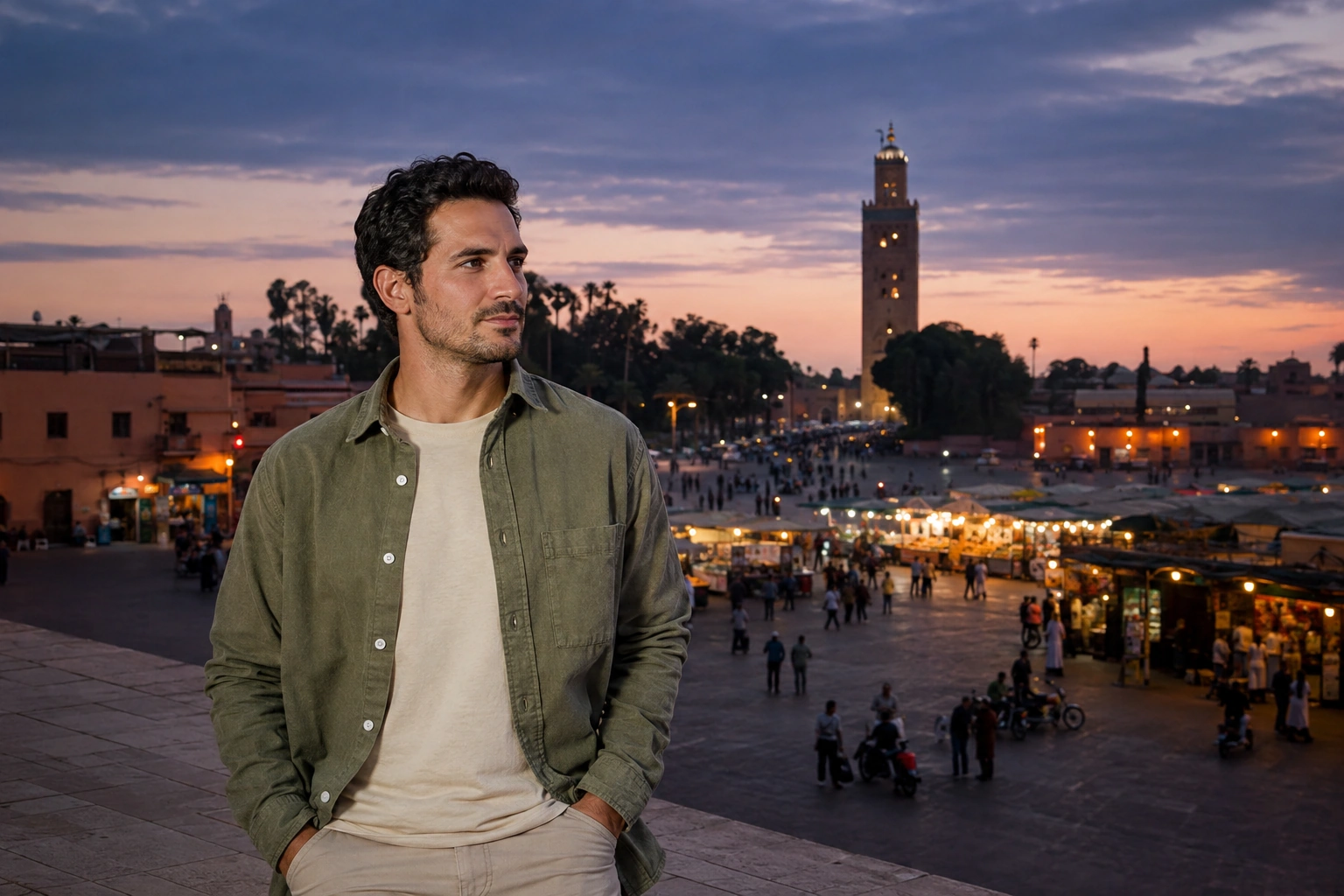
Marrakech at night mixes two questions that travelers tend to fuse: where should I physically stand this evening, and what will my night Memory require? The answers are different. The first depends on what stays open, what is lit, and how much heat and crowd you have left in you. The second depends on nothing but a verified unlock, because Unlocked’s night-direction Experiences are generated interpretations, not records of any particular evening.
Separating those two questions is the whole planning trick. This guide draws on UNESCO’s Jemaa el-Fnaa entry and the Unlocked catalog; it is advice, not a firsthand survey, and it promises no schedules.
What night actually changes in Marrakech
One place changes everything, and it is the square. UNESCO’s entry describes Jemaa el-Fnaa’s commercial and performance life running all day and well into the night — the food stalls, the storytellers, the musicians, the circles of spectators that give the square its listing. In a city where the great monuments close their gates, the square is the evening venue, and it is free.
What night does not change: the paid interiors. Bahia Palace, El Badi Palace, the Ben Youssef Madrasa, the gardens at Majorelle and Menara are all daytime sites. Their closing hours vary and shift; the honest planning rule is to treat every monument hour as something to verify for your dates, never as background furniture in an evening plan.
The evening shape that works
Illustrative evening plan, not a timed route: late afternoon at the Koutoubia gardens while the minaret catches low light — the exterior and gardens are the public side, since non-Muslim visitors cannot enter the mosque — then into Jemaa el-Fnaa as the stalls assemble and the performance circles form, then dinner at the square or one terrace drink above it, then the walk home through lanes that still carry craft shops with their lights on.
The medina after dark is a working district, not a stage set, and the same etiquette from the Jemaa el-Fnaa visit plan applies: agree before photographing anyone, buy something if you occupy a terrace table, and let the lanes’ residents have their street. Keep the ordinary-city discipline too — phone in a front pocket, valuables home, and no photograph is worth following anyone down an unlit detour.
The daytime sites, planned for their own light
The collection’s other evening frames are early, not late. El Badi Palace’s open sunken gardens and ochre walls are compositions for the last daylight hour, not for darkness — which is why the grouping guide puts it at the end of a palace day. The Menara Gardens basin and pavilion face open ground toward the Atlas mountains, and the garden’s placement on the airport side makes its golden hour a natural pairing with a departure or an evening arrival. Both close; check the current hours rather than planning the sunset backwards from a hope.
Incorrect example: arriving at a garden at dusk because the Experience is named Menara Golden Hour. Correct principle: the Experience name describes a generated creative direction, not an admission ticket to any hour. Complete the unlock during open hours, and the golden-hour interpretation can be created whenever you like.
Night Memories do not need night visits
Here is the part that surprises people. Lantern Blue Hour at Jemaa el-Fnaa, Ochre Evening at the Koutoubia, Menara Golden Hour: they sound like appointments. They are not. Each is a generated creative direction attached to its Landmark, available after any verified unlock, at any hour, on any later day. Complete the location check during a permitted visit, and the evening interpretation can be created from your riad the following morning.
The division of labor that follows is clean. Your camera photographs are the documentary record of the night you actually had — the heat leaving the stones, the stall smoke, the crowd current. The generated Memory is an interpretation, and should be identified as generated when shared. If you want both, earn the unlock in person and make the picture twice: once with the camera at the place, once with the Experience afterward.
When the evening collapses
Heat, fatigue, or a wrong turn can end any Marrakech evening early, and the plan survives it. The square at 9 p.m. is complete in itself; the minaret is visible from anywhere in the centre; one terrace covers the whole composition. Do not convert a flexible evening into a checklist. The first-visit grouping guide explains why one loose evening outperforms a second daytime sprint, and the heat-day plan explains why the hours before dusk belong to shade in the first place.
Useful details
Frequently asked questions
Are Marrakech's monument opening and lighting hours guaranteed?
No. Nothing in this guide reproduces venue hours as current. The square runs late by its nature, but palaces, gardens, and museums close on their own schedules, which change; verify each site for your dates before building an evening around it.
Can I unlock a Landmark from a rooftop terrace overlooking the square?
The location check verifies presence inside each Landmark's supported arrival area, and rooftop geometry varies building by building. Open the app and confirm the check completes where you stand; if it does not, unlock at street level first and enjoy the terrace as a view.
Do night-named Experiences require an evening unlock?
No. Lantern Blue Hour, Ochre Evening, and Menara Golden Hour are generated creative directions. Complete the physical-presence unlock at any permitted hour, then create the Memory later; your own night photographs remain the record of the evening you actually had.
Source notes
Sources
This article was prepared with editorial automation using the source pack below.
- Cultural space of Jemaa el-Fna SquareUNESCO Intangible Cultural Heritage
- Marrakech Landmarks and ExperiencesUnlocked
- Marrakech heritage map with site entries and admissionsMrrakc