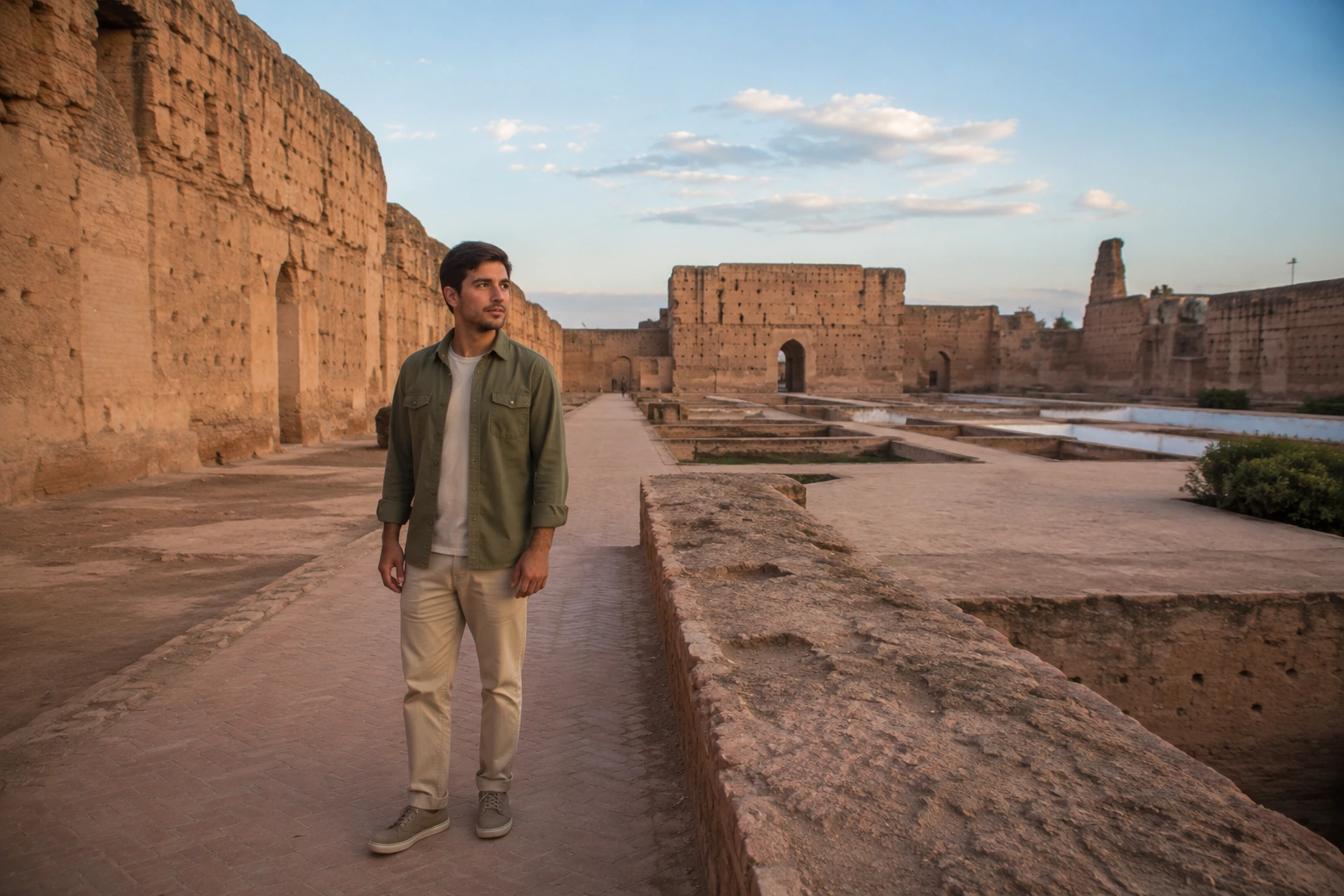
Every Marrakech packing list should include a plan for the hours between noon and mid-afternoon. The city is hot semi-arid by classification — Wikipedia’s climate table for Marrakesh records a long-run July mean daily maximum of 37.7°C, average annual sunshine of about 3,251 hours, and a record high of 49.6°C — and the nickname Red City describes walls of red earth that hold the heat and shade almost nothing.
A visitor who treats that as bad luck will spend the trip re-booking; a visitor who plans for it gets a different, still worthwhile, version of the city. This is that plan. It is built from the Unlocked catalog, UNESCO’s medina entry, the Mrrakc heritage map checked in September 2026, and the same editorial discipline as our other Marrakech guides: no firsthand weather survey, no temperature promises, and no claim that heat improves anything. Heat is a condition to schedule around.
Why the Red City punishes its own squares
The heat has an architecture, and the architecture is the city’s. Marrakech’s most famous spaces — Jemaa el-Fnaa, the Koutoubia’s open gardens, El Badi’s sunken courts, the Menara basin — are deliberately open, and open ground in the Red City at 2 p.m. is the most expensive real estate your energy can spend. The medina’s narrow lanes and courtyard houses, by contrast, are a shade technology centuries old; UNESCO’s entry describes a living town of lanes, souks, and fondouks packed tight enough to shadow its own streets.
So the noon strategy inverts the sightseeing instinct. The covered and carved interiors — Bahia Palace’s courtyards and painted cedar, the Ben Youssef Madrasa’s arcades, the souk network’s roofed stretches, and the roughly thirty museums the Mrrakc map catalogues, from the Dar Si Said weaving museum to the House of Photography — are exactly where midday belongs. The open landmarks are for the hours on either side.
The day split, as a shape
Illustrative day shape, not a timed route: early morning at an open landmark — the square before the crowd, or the Menara basin in flat light; late morning through midday inside Bahia, the Madrasa, or a museum, with the covered souks between; late afternoon emerges into the lanes as the shadow lines lengthen; the last light goes to El Badi’s open ruins or a terrace above the square, where the evening version of the city begins.
Incorrect example: a noon arrival at Jemaa el-Fnaa to “see it at its busiest,” followed by an afternoon circuit of the open gardens. That spends the two hottest hours on the two most exposed stops and the shaded hours indoors. Correct principle: match each landmark to the hour that flatters it, which in this city is also the hour that spares you.
Two practical notes from the same logic. Water and mint tea are the schedule, not a refreshment: build the stops where you sit down into the plan, and let the juice stalls on the square be the morning habit rather than a noon sprint between sights. And shops, venues, and sites keep their own hours, which vary; treat every stated hour anywhere as a thing to verify for your dates.
Heat changes comfort, not verification
The unlock check verifies presence inside each Landmark’s supported arrival area, and temperature is not part of the calculation. A 40-degree noon unlocks exactly like a May morning; confirm success before leaving, as always. If standing in the open to complete the check is the uncomfortable part, remember the supported area has edges: the shaded side of a courtyard counts the same as its sunlit centre. Access restrictions and closures take precedence over any plan, hot or mild.
Keep a record of the actual day
There is a documentary honesty question hiding in heat-day photography, and it mirrors the fog question from our Chongqing grey-day guide: your camera photographs of white light, empty squares, and heat-shimmered walls are the true record of the day you had. Keep them.
The Experiences are a different category. Ochre Evening at the Koutoubia, Menara Golden Hour, Ruins in Gold at El Badi: their names describe generated creative directions, not the light at your unlock. Do not read a name as a forecast, and do not present the output as evidence of conditions. Generated Memories are interpretations to be labeled as generated; camera photographs are evidence. The general guide to imperfect photo weather covers the expectations side of this in depth.
When to reschedule instead
Flexibility is the last lever. If your dates allow, keep the open Landmarks for the edges of the day and let the noon belong to Bahia, the Madrasa, and the museums — the unlocks stay valid whenever you complete them, and Memories can be created later regardless. If a heatwave rewrites the week entirely, run the split-day plan without regret: the first-visit grouping guide shows which stops combine by quarter, and the after-dark guide explains why the city’s best hour starts when the stones finally give the heat back. In the Red City, the heat is not a review of your trip. It is the reason the courtyards exist.
Useful details
Frequently asked questions
Does heat affect my Landmark unlock?
No. The location check verifies presence inside each Landmark's supported arrival area using positioning, not temperature or visibility. Complete the unlock as usual and confirm success before leaving; if you are not comfortable standing in the sun to do it, unlock at the shaded edge of the supported area.
Should I skip the open squares at noon?
Yes — that is editorial guidance, not a rule. The square, the gardens, and the open ruins cost you the most at midday, while the covered courtyards and museums cost you the least. If your dates allow flexibility, save the open spaces for the hours on either side.
Which months are cooler in Marrakech?
We make no month-by-month promises here. The long-run climate normals make summers hot and winters mild, and individual days vary; check the forecast and any heat advisories for your own dates before locking an itinerary.
Source notes
Sources
This article was prepared with editorial automation using the source pack below.
- Marrakesh city and climate profileWikipedia
- Medina of MarrakechUNESCO World Heritage Centre
- Marrakech Landmarks and ExperiencesUnlocked
- Marrakech heritage map with site entries and admissionsMrrakc