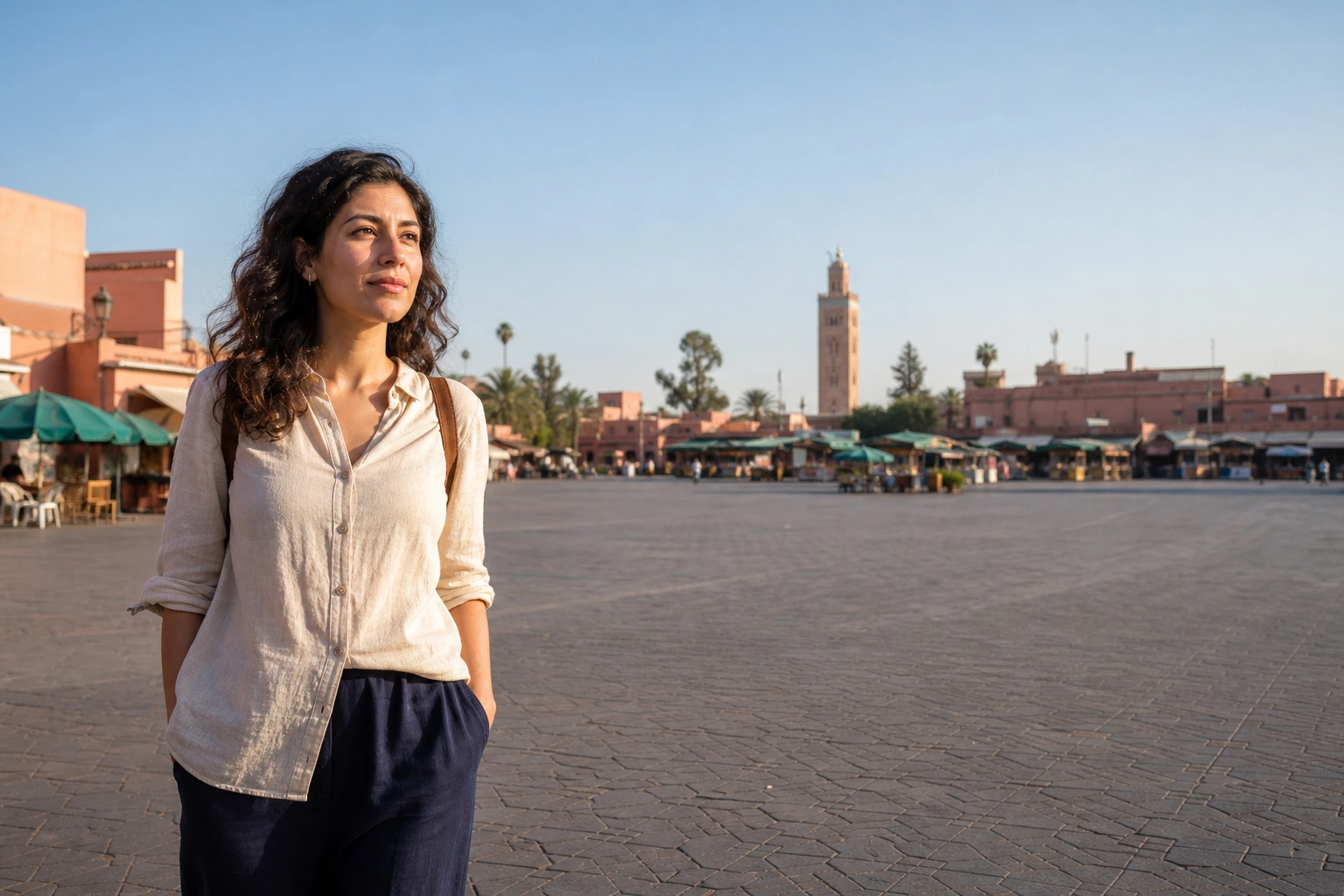
Jemaa el-Fnaa rewards visitors who arrive with the right expectation: this is not a square with a show attached, it is a square that has earned its living from performance for close to a thousand years. UNESCO’s intangible heritage entry calls it one of the city’s main cultural spaces since its foundation in the eleventh century, a triangular square at the medina’s entrance where oral storytellers, musicians, and trades have always shared the ground.
The disappointment pattern is predictable, and avoidable: a visitor crosses the square at an arbitrary hour, finds it either half-empty or overwhelming, photographs the same three stalls, and leaves without noticing that the place was designed to change completely several times a day. This guide is a set of planning decisions drawn from UNESCO’s entry, the Unlocked catalog, and the Mrrakc heritage map checked in September 2026. It is not a firsthand crowd survey, and it promises no schedules.
Know what the square actually is
UNESCO’s entry describes the inventory directly: through the day, dental care and traditional medicine, fortune-telling, henna tattooing, water-carrying, fruit and traditional food; as the light drops, storytellers and poets, Berber musicians, Gnaoua dancers and senthir players. Morocco has protected these traditions as part of its artistic heritage since 1922, and the square was among the first places proclaimed a Masterpiece of the Oral and Intangible Heritage of Humanity in 2001, before the 2008 inscription.
That history explains the layout you will actually walk: an open triangle with the Koutoubia minaret on its horizon, café terraces stacked along the edges, and the souks spilling in from the north. It also explains the density. A square that has been a stage since the eleventh century does not thin out because a guidebook said it might.
The changeover, honestly hedged
The square’s most useful feature is that it runs on two clocks. The morning is for logistics and orientation — juice stalls, the gardens across at the Koutoubia, the square’s geography with few spectators. The evening is the version UNESCO was describing when it listed the square’s commercial and performance life running well into the night.
Our editorial guidance, not a promise: plan one evening arrival and one morning pass. The evening gives you the changeover itself, the food stalls assembling, the crowd current forming. The morning gives you the square readable — its shape, its edges, where the terraces are, which lane out leads where — with room to breathe. A visitor who only ever crosses at noon gets the worst of both.
The attention economy
Almost everyone working the square is working. Performers gather audiences in circles; henna artists and water-sellers pose and serve; stallholders call. The rule that keeps the visit clean: agree before you photograph. A raised camera inside a performance circle is a transaction, whether or not you meant it as one. Watch from the edge first, decide whether the performance is one you want to support, and settle expectations before any close frame.
Incorrect example: treating the circles as free street theatre and photographing performers mid-routine from a metre away, then objecting when payment is requested. Correct principle: the performance is the product; watching from the edge is free, a close photograph is negotiated, and walking on is always a legitimate choice.
One stance we state plainly: we recommend declining the posed animal photographs — the snakes and macaques offered as props at the square’s edges. Welfare researchers have documented the harm in those trades, and the photograph costs you nothing to skip. Editorial stance, not a claim about any individual handler.
Terraces are context, not the square
The café terraces around the square’s edge sell the best viewpoint in Marrakech for pennies relative to palace admissions, and they are worth one visit — the square reads as a composition from above in a way it never can from inside. But keep the two experiences separate in your plan. From a terrace you are an audience; inside the square you are in the current of it. A visit that consists of one terrace drink has not met the square; a visit that never gets height misses its geometry.
The same division applies to the app: the Landmark check verifies presence inside the supported area around the square. A rooftop photograph is a photograph. If you plan to unlock from a terrace, open the app and confirm the location check actually completes before you count it; otherwise unlock at street level before you go up.
Eating at the square
The evening food stalls are part of the listed heritage — traditional food sold on the square is in UNESCO’s description, not an add-on for tourists. Practical decisions, offered as editorial guidance and not venue endorsements: prefer stalls with turnover and posted prices, order the classics rather than improvising — harira soup, grilled skewers, the slow-roasted lamb the city is known for — and let the juice sellers be your noon habit rather than your evening one. If your stomach has opinions about street food, the terraces above the stalls serve the same view with a quieter kitchen.
The unlock and the three Experiences
The Jemaa el-Fnaa Landmark verifies presence inside its supported area across the square. Open the Landmark in the app, choose Unlock while inside the boundary, and confirm success before leaving — the check for the square does not cover the Koutoubia across the way, and vice versa.
Afterward, three Experiences interpret the place: Square First Light, Lantern Blue Hour, and Medina on Film. Their names are creative directions, not schedules or reservations. You can unlock at a hot noon and still create the blue-hour Memory later, because the unlock records where you were, not the mood you were promised. The after-dark guide covers which night interpretations need which planning, and the grouping guide places the square inside a full day.
Useful details
Frequently asked questions
Is there an entry fee for Jemaa el-Fnaa?
No. The square is a public space; the Mrrakc heritage map lists public access at no charge, and cafés, terraces, and food stalls set their own prices. Confirm current arrangements locally, since individual venues change terms independently of the square.
When does the square switch from day mode to night mode?
No switch time is promised here, and none is published. As editorial guidance, the changeover happens around dusk: food stalls assemble in late afternoon and the performance density peaks after dark. Arrive before full dark once if you want to watch the square change costumes.
Does the Lantern Blue Hour Experience include a night visit?
No. Its name describes a generated creative direction shaped by warm stall lights and a blue evening sky. Complete the physical-presence unlock at any permitted hour, then create the Memory later; your own photographs remain the record of the evening you actually had.
Source notes
Sources
This article was prepared with editorial automation using the source pack below.
- Cultural space of Jemaa el-Fna SquareUNESCO Intangible Cultural Heritage
- Marrakech Landmarks and ExperiencesUnlocked
- Marrakech heritage map with site entries and admissionsMrrakc