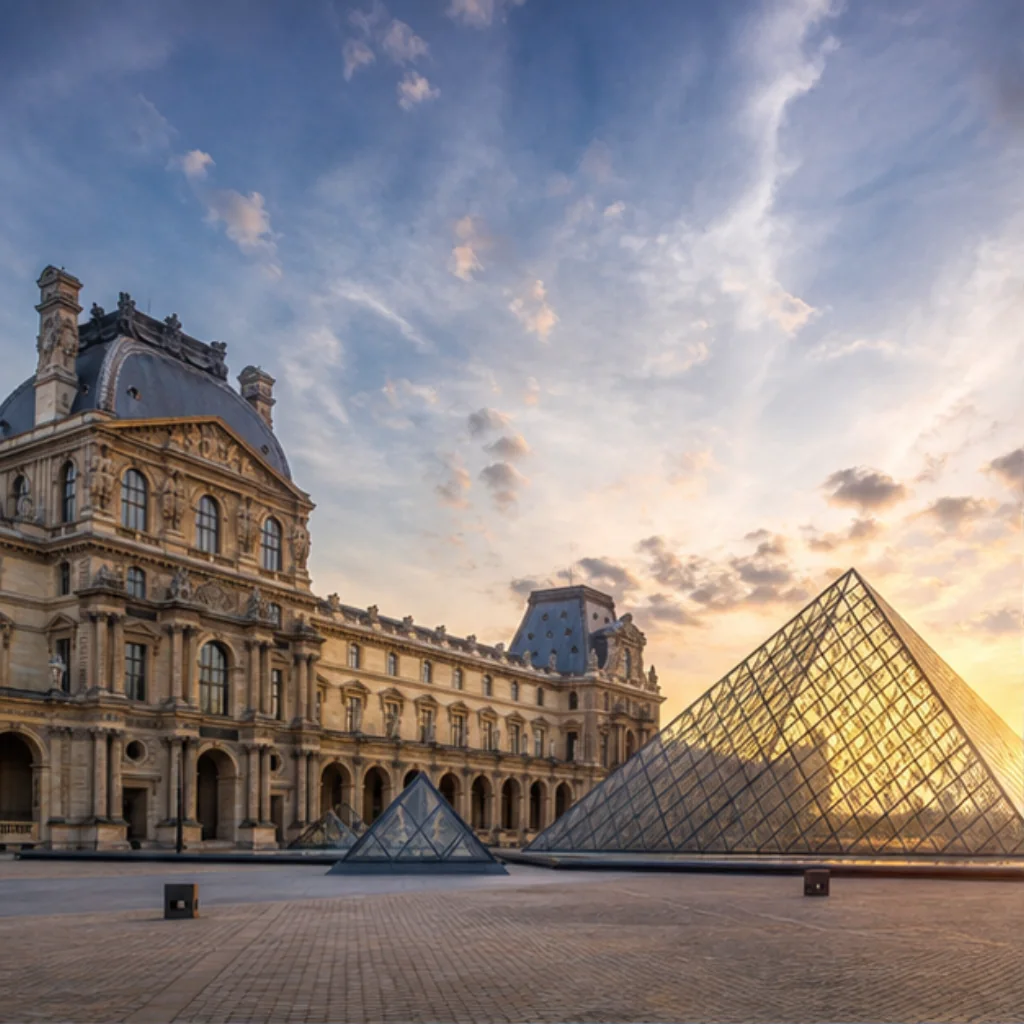
The first decision you make at a landmark can be where to stand for the picture. We would like to leave room for an earlier one: where to stand because you want to look.
A camera frame asks you to select. It needs an edge, a subject, a background, and a moment to press the button. Those choices can be pleasurable. They can also arrive before you have had a chance to find out what interests you about the place.
At Unlocked, we believe the first look deserves some space of its own. You have already made the journey. There is no reason to begin by solving the portrait.
Notice what the familiar picture left out
You may arrive knowing the outline of a landmark from photographs. Recognition is only the beginning of seeing it in person.
An illustrative example: you arrive at the Louvre expecting to look at the pyramid. Once there, you find yourself interested in the space around it, the relationship between the glass and surrounding buildings, or how the courtyard changes as people move through it.
Following that interest does not require an architectural vocabulary. You can simply stay with the thing that caught your eye. Walk to another permitted viewpoint. Look back. See whether the detail still holds your attention.
If you immediately recreate a familiar composition, you have already chosen what matters in the scene. Giving yourself a first look leaves that choice open a little longer.
Remove one decision from the arrival
Unlocked lets you separate being at a place from creating a portrait associated with it. At a supported Landmark, choose Unlock while nearby and wait for the app to confirm it succeeded.
That successful unlock remains attached to your account after departure. You can put the phone away without selecting an Experience or starting a Memory.
Later, an available Experience gives you a curated photographic direction for the landmark. With a photo of yourself and the required credits, you can create an AI-generated Memory back at your hotel or after the trip.
You still need the phone to complete the unlock. The benefit is that the rest of the image-making does not have to follow immediately. Unlocked’s presence-first approach is built around that separation.
Give yourself permission to have no technique
Advice about being present can turn into another assignment: count the sounds, identify five details, sit for a prescribed length of time, write a reflection. Any of those can be useful if you enjoy them. You do not need to pass an observation exercise to appreciate a building.
Start with a simpler question: what would you look at if you were not deciding what to photograph?
The answer might be a small piece of ornament. It might be the whole skyline. It might be the expression on the face of the person you came with. You are allowed to follow it without documenting the result.
There is also no required emotional response. A famous place may leave you surprised, curious, unmoved, or tired. Taking an impressive picture should not become a way to manufacture the reaction you think the visit was supposed to produce.
Make the image after you know what you liked
Choosing a Memory later gives you time to discover what you want from the image. Perhaps you want a portrait with a particular mood. Perhaps the photographs you took are already enough, and you leave the creative option for another day.
An AI-created Memory is an interpretation, so keep any original photographs that record details you want to preserve exactly. More Memories require credits and available Experiences; the unlock keeps the visit connected to those later choices.
Our preference is to make the arrival less crowded with decisions. Let the first look happen. A good reason to create a picture can come after you have found your own reason to care about the place.