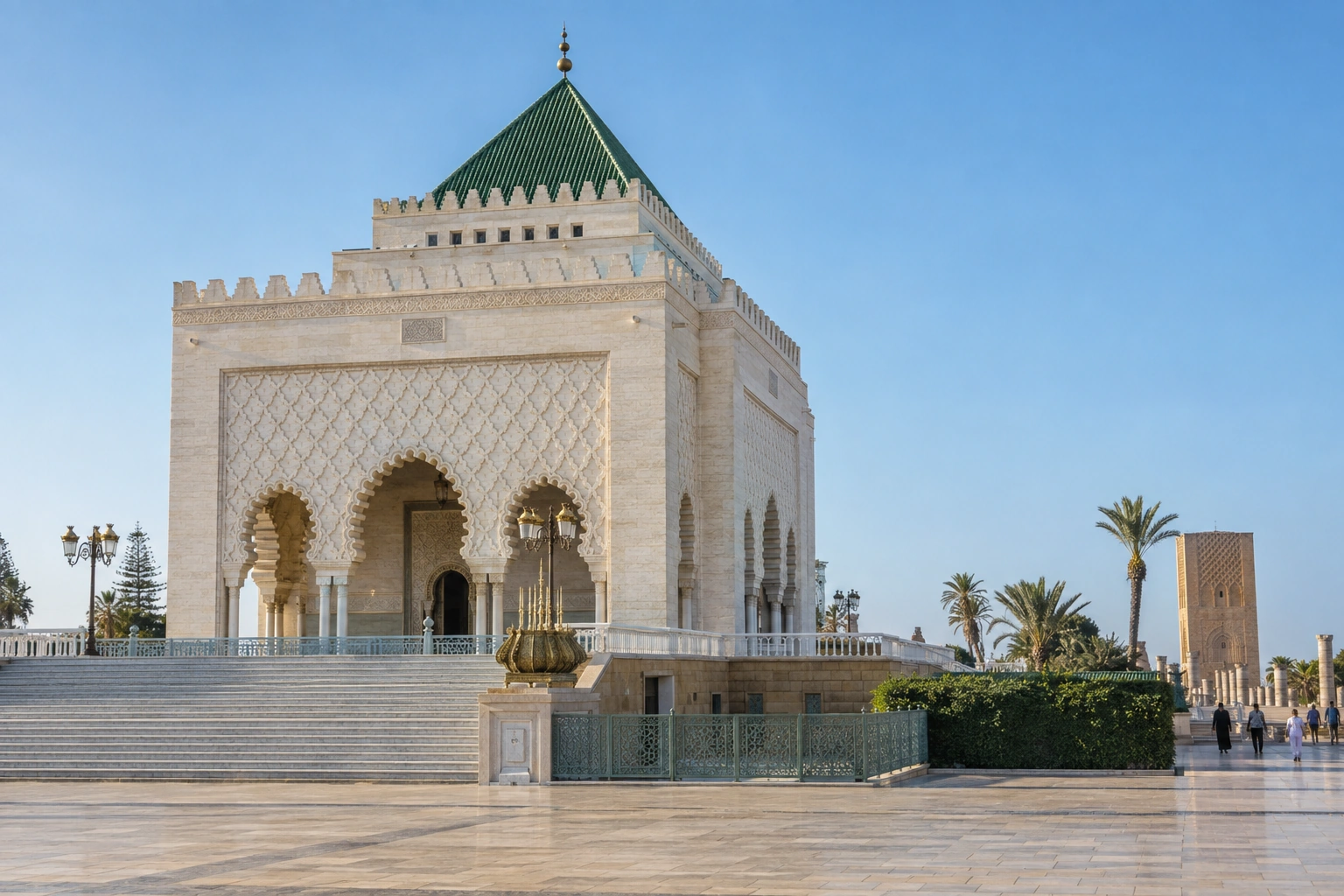
If you have a week in Morocco and room for one imperial city besides the coast, the choice usually comes down to Rabat or Marrakech. They are both former imperial capitals, both UNESCO-listed, both walkable, and both rich enough to fill four days. So the tiebreaker is not quality. It is intensity, and which direction you want it calibrated.
The useful frame: Marrakech concentrates; Rabat distributes. Everything that makes Morocco vivid is present in both cities — the craft, the tilework, the monumental building, the food — but Marrakech packs it into a dense medina core and turns the volume up, while Rabat spreads it along a river mouth and an ocean and turns it down. Neither calibration is the wrong one. They suit different trips.
What Marrakech concentrates
Marrakech’s listed medina is the main event, and nearly everything happens inside or just outside its walls. Jemaa el-Fnaa is a square that becomes a nightly festival of food stalls, storytellers, and musicians; the Koutoubia minaret anchors the skyline; the souks run for lanes and lanes behind it. The palaces and the Ben Youssef Madrasa put carved wood, zellige, and plasterwork at close range, one courtyard after another.
What that concentration buys you: everything is at hand, the palette is famously vivid — the red of the walls, the dye pits, the lantern souks — and the evenings are an attraction in themselves. What it costs you: the medina is demanding. Being invited into shops, navigating lanes that resist navigation, and sharing famous courtyards with most of the visitors in the city is part of the experience, not a defect, but it is work, and by day three some travelers are tired of it. If you want your trip to feel like an event, choose Marrakech.
What Rabat distributes
Rabat’s UNESCO listing is deliberately different in kind: it honours a modern capital sharing ground with a historic one. What that means on the ground is that the city’s monuments sit in open space rather than on top of each other. The Hassan Tower esplanade is a vast open platform beside the river; the Kasbah of the Udayas holds its blue lanes above the Atlantic; Chellah keeps a walled necropolis and a stork colony to itself; the palace mechouar, the national museum of modern art, and the art deco cathedral line a planted civic avenue.
The register is quieter in a way that is easy to underrate. The kasbah lanes have the same blue-and-white charm as any postcard street in Morocco with a fraction of the foot traffic; the craft traditions are in the capital’s museums rather than only its souks; and the ocean sets the light and the temperature. Being a working political capital also shapes the streetscape — government buildings, ceremony, guards, a city that is partly about Morocco’s present rather than only its past. If continuous intensity tires you, or you are travelling with people it tires, choose Rabat.
A test that usually settles it
Illustrative example — not a rule, just a decision aid that travelers report matching their experience:
- If you would rather come home saying “I was inside the noise” and accept that the noise will sometimes find you, Marrakech.
- If you would rather come home having actually sat still — on a terrace over the river mouth, in a garden full of storks, on an empty esplanade of 12th-century columns — Rabat.
First-time visitors with energy and three to four concentrated days tend toward Marrakech. Travelers on a second Morocco trip, or pairing the city with work, or moving at family pace, tend toward Rabat. Neither tendency is a verdict on the cities.
The photographer’s version of the choice
The two cities hand a camera different materials. Marrakech is dense, warm-toned, and vertical: lanes, arches, dye color, lantern light — frames you build by exclusion. Rabat is open, pale, and horizontal: a 44-metre minaret against sky, white lanes trimmed in blue, ocean light on ramparts — frames you build by geometry. If your best travel photographs tend to be close and saturated, Marrakech will cooperate. If they tend to be composed and airy, Rabat will. The esplanade and kasbah photo guide and the Marrakech medina and palace guide show the difference in practice.
Doing both
The false assumption is that this is an either-or. Rabat and Marrakech are connected by the conventional rail line, roughly three and a half to four and a half hours apart through Casablanca, arriving at Rabat Agdal — ONCF runs the current timetables. A week holds both comfortably: three or four days in Marrakech, a morning train, two or three days in Rabat, and you exit the country having seen both calibrations of the same culture. Casablanca’s airport sits on that line about an hour to an hour and a half from Rabat, which makes “fly into Marrakech, out of Casablanca” the natural open-jaw.
Both cities carry seven Unlocked Landmarks each, every badge is permanent, and presence is verified at each site when you are there. Start with whichever city you land in: the Rabat collection or the Marrakech collection. If Rabat is the one you chose, the two-day grouping guide is the practical next step.
Useful details
Frequently asked questions
Is Rabat worth visiting if I have already seen Marrakech?
Yes, and for a specific reason: Rabat is not a smaller Marrakech. The UNESCO listing frames it as a modern capital sharing ground with an historic one, so the kasbah, the Almohad esplanade, and the avenue landmarks give you a version of Morocco the medina cities do not.
Can I collect Unlocked badges in both cities?
Yes. Rabat and Marrakech each have seven supported Landmarks with their own arrival checks and badges. Presence is verified per Landmark, and nothing in one city affects unlocks in the other.
How long is the train between Rabat and Marrakech?
Roughly three and a half to four and a half hours on the conventional line, arriving at or departing from Rabat Agdal. Check ONCF for current timetables, and build in buffer time if you have a same-day connection.
Source notes
Sources
- Medina of MarrakechUNESCO World Heritage Centre
- Rabat, Modern Capital and Historic City: a Shared HeritageUNESCO World Heritage Centre
- Moroccan National Railways schedulesONCF
- Rabat Landmarks and ExperiencesUnlocked
- Marrakech Landmarks and ExperiencesUnlocked