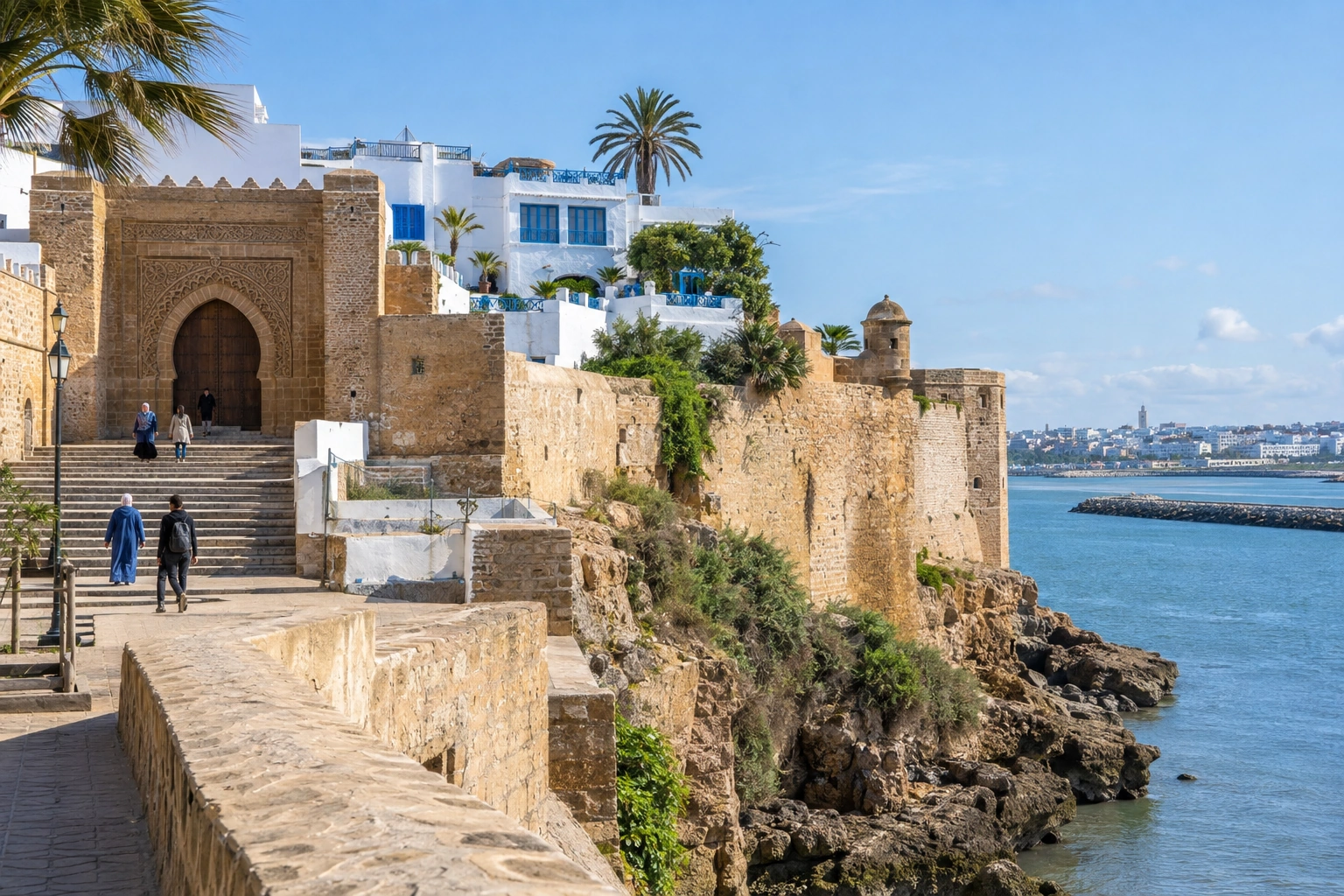
Rabat’s riverside gives a camera three Almohad-era settings within one short stretch of the city, and each one asks a different question. The Hassan Tower esplanade is a problem of geometry under open sky. The Mausoleum of Mohammed V is a problem of formality — white marble, green tile, and a site that still functions as a royal memorial. The Kasbah of the Udayas is a problem of scale — tight blue lanes that reward a phone as much as a camera, ending at a terrace over the Atlantic.
The mistake is carrying one photographic intention to all three. Decide what each stop is for before you arrive, and the Rabat collection becomes three distinct outings rather than three versions of the same portrait.
Hassan Tower: work with the column field
The tower is the famous object, but the esplanade is the actual scene. Begun in 1191 as the minaret of what was intended to be the largest mosque in the western Islamic world, the project stopped at 44 metres in 1199, and what remains beside the finished minaret is a vast platform of column stumps — hundreds of them, laid out in ranks you can walk through. The tower is not climbable, so plan your images around ground you can actually stand on.
Two approaches earn their keep here. A wide frame from inside the column field, with a person among the stumps, gives the site its true scale — the columns read as a rhythm, and the tower rises behind them. A tighter frame built on the tower’s carved horseshoe arches and stone bands, from a permitted position on the edge, gives you the detail the wide shot loses. Morning light comes across the river; late afternoon warms the stone. You do not need either — you need to pick one and give it ten unhurried minutes.
The Hassan Tower Landmark page keeps its own arrival area, distinct from the mausoleum’s, even though the two share the esplanade. Confirm both checks while you are there rather than assuming one covers the other.
Mausoleum of Mohammed V: formal, and about the building
Completed in 1971 on the esplanade’s southern edge, the mausoleum is a white marble cube under a green tiled pyramidal roof, with zellij and carved plaster inside and honor guards at the entrance. It is free to enter and visitors are welcome, which changes the photographic problem: this is the one interior on this stretch, and it behaves like a ceremonial space rather than a ruin.
The reliable compositions are quiet ones. From the terrace, pair the white mass of the building against the green roofline with nothing else competing in the frame. Inside, choose between the zellij mosaic of the entrance portal and the view down toward the onyx tomb — not both in one image. If someone in your group stands in the frame, give them space; the building is pale enough that a dark jacket reads as a strong shape from a distance.
One rule matters more than any composition: keep the guards out of close framing, and treat any ceremony you encounter as something happening around you, not material for your camera. The landmark page says the same thing in fewer words, and the current visitor hours are published by Visit Rabat.
Kasbah of the Udayas: three pictures in one citadel
The kasbah packs more photographic variety into less ground than anywhere else in Rabat, and it splits cleanly into three settings. Sequence them in the order you meet them.
Bab Oudaya, the gate. The monumental carved portal is the kasbah’s front door and its most formal single frame. The stone carving is dense, so a straight-on, centered composition does more here than an angle. Pass through it; do not only photograph it.
The blue-and-white lanes. Inside, the lanes are whitewashed with blue trim, narrow enough that a normal lens sees wall-to-wall. This is close-quarters photography: follow the light rather than fighting it, let a companion walk a few steps ahead, and photograph the lane as a shape rather than trying to flatten yourself against a wall for a “symmetrical” shot. The lanes are also people’s front doors — ask before making a doorway or a resident the subject, and treat the café terraces as ordinary private premises.
The terrace and the Andalusian Garden. The garden inside the kasbah’s gate enclosure gives you shaded, structured frames — fountains, oranges, rows of hedges — which photograph best when you crop tightly rather than trying to hold the whole garden. The terrace lookout at the kasbah’s edge is the payoff: ramparts, the Bou Regreg mouth, Salé across the water, and the Atlantic behind it. Late afternoon, when the light comes off the ocean, is the strongest window; it is also the busiest, so decide whether your frame is the view or the person looking at it, and make that choice before you raise the camera.
The lanes and garden are free; the museum pavilion keeps its own hours (closed Tuesdays at the time of writing, per Visit Rabat) and its own ticket.
Keep the record straight
The camera images you make along this stretch are the record of the conditions you actually had — the wind on the terrace, whatever the light was doing. An Unlocked Experience such as River Mouth View or Kasbah on Film produces a generated Memory from your reference photos after a successful unlock; it is an interpretation, clearly labelled when shared, not a replacement for the frame you made on the wall yourself.
For the planning version of this stretch — order of stops, timing, and how it chains into the rest of the city — read two days in Rabat. For the city’s one ticketed garden, the Chellah photo guide is the companion piece.
Useful details
Frequently asked questions
Is this a tested walking route between the three sites?
No. These are photographic choices for three sites that happen to sit along the same riverside stretch of central Rabat, not a verified route or a promise they fit one outing. Check a current map and each site’s arrangements before you go.
Can I photograph the honor guards at the mausoleum?
Keep guards and any ceremony out of close framing. The mausoleum is a working royal memorial; the reliable approach is the building, its materials, and your companions, with the guards respected as personnel rather than as subjects.
Do I need the light shown in the Experience previews?
No. Previews are illustrative generated artwork showing a treatment, not a prediction of conditions. Your camera photographs record the real light; a generated Memory made later is a separate creative interpretation.
Source notes
Sources
- Rabat Landmarks and ExperiencesUnlocked
- The Mausoleum of Mohammed VVisit Rabat
- Museum of the OudaiasVisit Rabat
- Rabat, Modern Capital and Historic City: a Shared HeritageUNESCO World Heritage Centre