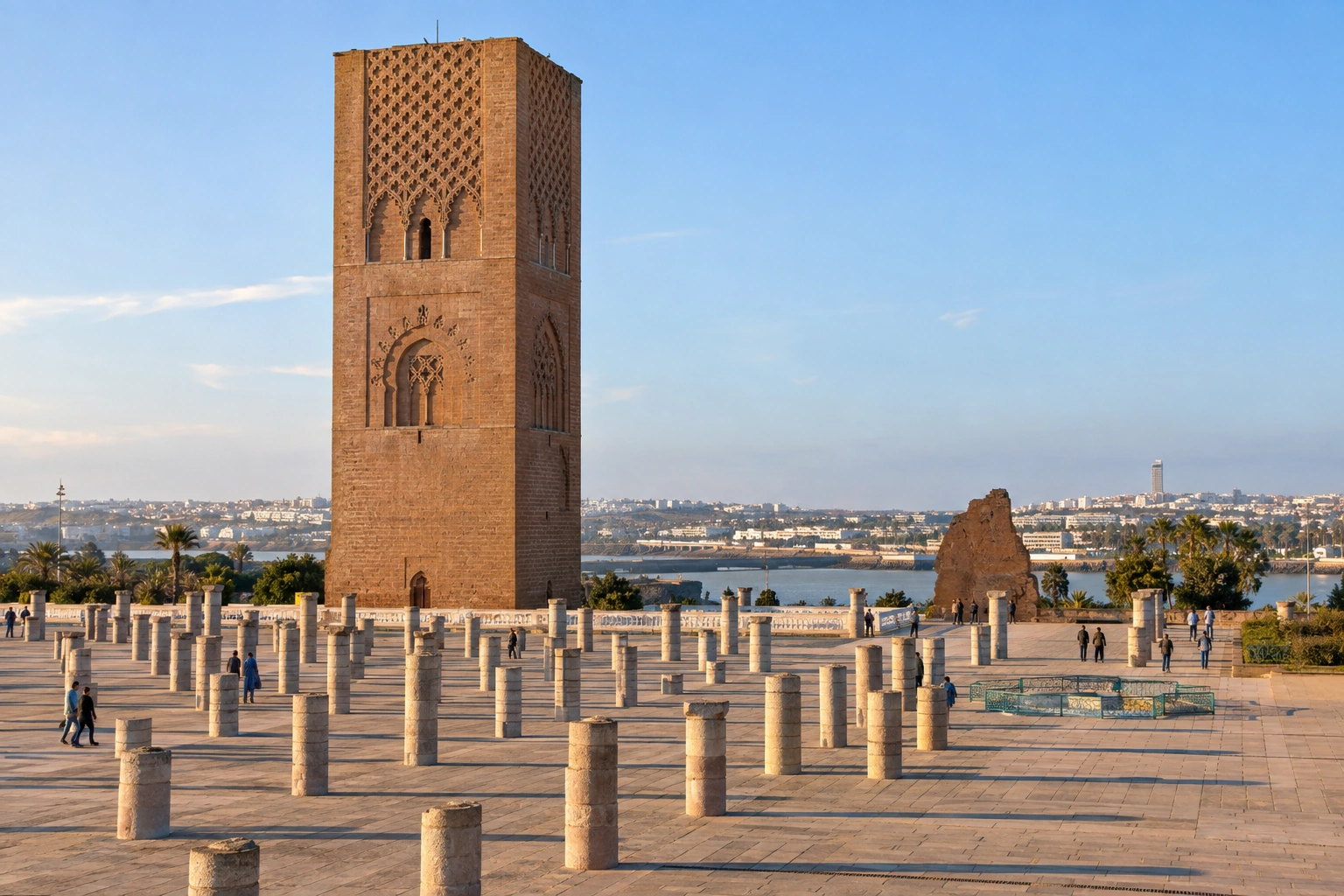
Rabat is the rare capital where the main sights genuinely fit into a short visit. The city’s UNESCO listing, “Rabat, Modern Capital and Historic City: a Shared Heritage”, names exactly the areas a visitor cares about: the Almohad esplanade, the kasbah at the Bou Regreg mouth, the Chellah necropolis, and the planned avenues of the colonial-era capital. All seven Rabat Landmarks sit inside that central ring.
The mistake to avoid is treating the seven as a list of separate destinations. They are not. Rabat’s sites sort into three clusters that match how the city was built, and once you see the clusters, two unhurried days covers everything with room left over for a long lunch. The real constraint is not distance — it is opening rhythms: one museum closes on Tuesdays, one site keeps seasonal hours, and two landmarks share a single esplanade.
Three clusters, not seven stops
The first cluster is the Almohad riverside. Hassan Tower and the Mausoleum of Mohammed V stand at opposite ends of the same open esplanade beside the Bou Regreg river. You will walk from one to the other in a few minutes across free, ticket-less ground. In the app they remain two separate Landmarks with two separate location checks — one arrival area, two unlocks.
The second cluster is the river mouth. The Kasbah of the Udayas sits at the point where the Bou Regreg meets the Atlantic, attached to the edge of the medina. Lanes, the Andalusian Garden, and the terrace viewpoint are free to enter; the small museum pavilion inside keeps its own hours and its own ticket.
The third cluster is the south and the civic axis, and it is really two short groupings that chain together easily. Chellah is the walled necropolis southeast of the centre. The Royal Palace mechouar lies west of it — exterior views only, from the public parade ground. From there the Mohammed VI Museum of Modern and Contemporary Art and Saint Peter Cathedral line up along the same avenue axis leading back toward the medina, a short walk apart from each other.
Day one: the river and the ocean
Start at the esplanade in the morning, when the light comes low across the river and the column field throws long shadows. The tower itself is not climbable; the visit is the open ground, the 44-metre minaret, and the forest of unfinished 12th-century column stumps. Walk the full length to the mausoleum, which is free to enter and remains a working royal memorial — honor guards stand at the entrance, and the sensible courtesy is to keep them out of close framing.
Give this cluster a slow hour. Then walk west and south through the medina toward the kasbah for the afternoon. Entering through the monumental Bab Oudaya gate is the intended sequence: the carved Almohad portal first, then the blue-and-white lanes climbing toward the ocean light, the shaded Andalusian Garden, and finally the terrace lookout over the river mouth, Salé on the far bank, and the Atlantic. Late afternoon is when that terrace is at its best, and when the lanes photograph most easily.
Two cautions for day one. The kasbah’s museum pavilion and the Mohammed VI Museum both close on Tuesdays — if your first day is a Tuesday, keep it outdoors as planned and shift the museum to day two. And the kasbah is a lived-in place: private houses and café terraces are ordinary private premises, not photo sets.
Day two: gardens, gates, and the avenue
Make Chellah your first stop, close to opening. It is the one ticketed heritage garden among the seven — entry was 70 dirhams at the time of writing, and the official site sells tickets and publishes current hours, which run later in summer (through 30 September) and earlier in winter (from 1 October). The site holds three layers at once — Roman Sala Colonia, the Merinid necropolis built over it, and the gardens that now grow through both — plus the storks that nest on the ruined minaret. An hour and a half is a realistic minimum; the Chellah photo guide covers how to use that time with a camera.
From Chellah, head to the Royal Palace mechouar. This is an exterior Landmark by design: the palace buildings and grounds are closed, and the visit is the vast parade ground, the ambassador gates, and their tilework, viewed from permitted public ground while guards manage the inner approaches. It is the quickest of the seven — plan minutes, not hours.
Finish on the civic axis. The Mohammed VI Museum, open 10:00 to 18:00 and closed Tuesdays, is Morocco’s national museum of modern and contemporary art; exhibitions change, so check the museum foundation’s information for what is on during your visit. Saint Peter Cathedral stands a short walk up the same axis — an art deco landmark from the protectorate era that remains an active church, with public street frontages and parish rules for the interior.
Plan around Tuesday before you plan anything else
If your trip includes a Tuesday, that is the day for the esplanade, the kasbah lanes and garden, and Chellah — all sites whose outdoor experience does not depend on the two museums that close that day. This single constraint does more to shape a good Rabat plan than any optimisation of walking routes. Verify closures close to your visit; Moroccan museums also adjust hours around public holidays and Ramadan.
Getting there and between
Central Rabat is compact enough that the clusters chain on foot, with the tram linking Rabat and Salé across the river if your base sits on either bank. Arriving from Casablanca, trains reach Rabat Ville or Rabat Agdal in roughly one to one and a half hours, and the high-speed line serves Rabat Agdal toward Kenitra and Tangier; check ONCF schedules for current times. Rabat–Salé airport has no rail link — allow for a bus or taxi transfer of fifteen to twenty minutes into the centre.
Collecting the seven
Each Landmark keeps its own supported area and its own location check, so confirm each unlock while you are actually there — including both stops on the shared esplanade, which count separately. The first GPS unlock grants one welcome credit once per account, not one per landmark. Badges are permanent once earned, which is exactly why the two-day plan can stay relaxed: nothing expires if you return to your hotel with one column field unfinished.
For the photographic side of each cluster, the esplanade and kasbah photo guide and the Chellah deep dive pick up where this planning article stops.
Useful details
Frequently asked questions
Is this a tested two-day itinerary?
No. It is a grouping logic built from how central Rabat is laid out, not a timed schedule we have walked. Check a current map, each venue’s published hours, and your own pace before committing to any order.
Does the Unlocked app cover admission or transport between these sites?
No. Tickets, trams, taxis, and guided visits are separate from the app. Unlocked verifies your presence at each Landmark and grants its badge; Chellah and the Mohammed VI Museum keep their own ticketing.
Can I spread the seven Landmarks over more than two days?
Yes, and it is often the better choice. Two days is the comfortable minimum because the sites cluster together, not a requirement. Each badge is permanent once earned, so splitting the visit across a week costs you nothing.
Source notes
Sources
- Rabat Landmarks and ExperiencesUnlocked
- Rabat, Modern Capital and Historic City: a Shared HeritageUNESCO World Heritage Centre
- Chellah practical informationChellah official site
- Mohammed VI Museum (MMVI) informationFondation Nationale des Musées
- Moroccan National Railways schedulesONCF