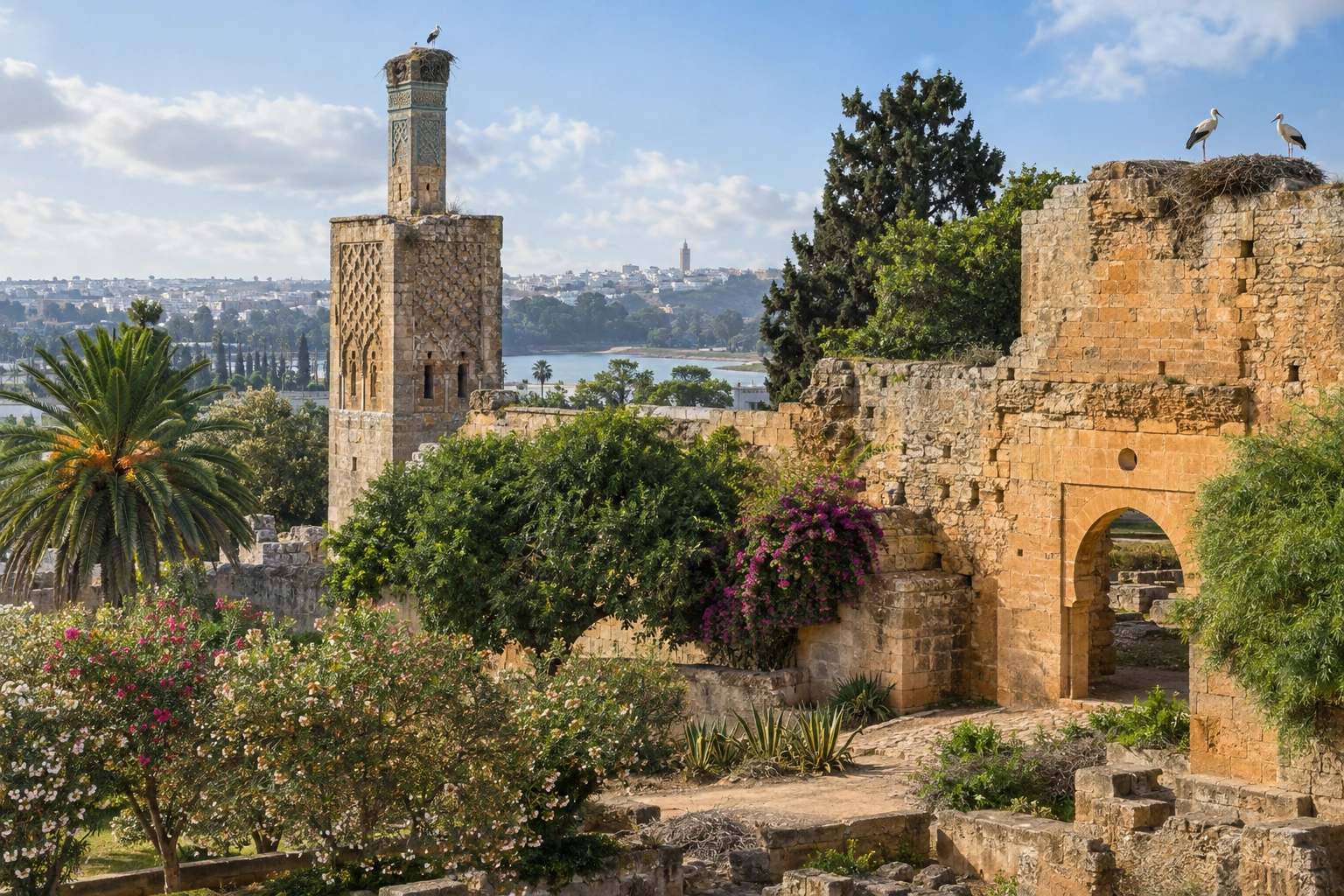
Chellah is the one site in Rabat where the city’s whole timeline sits inside a single wall. The Romans built Sala Colonia here. The Merinids walled the ground into a royal necropolis in the 13th and 14th centuries and left a mosque and minaret among the tombs. After the 1755 Lisbon earthquake broke the complex, gardens grew through the wreckage, and today the walled enclosure — part of Rabat’s UNESCO listing — works as a heritage garden where storks nest on the ruined minaret and cats hold the shade.
That density is why Chellah deserves more planning than the free sites. It is ticketed, it keeps hours that change with the seasons, and the difference between a rushed circuit and a good visit is mostly about when you arrive and what you decide to look at.
What the ticket buys, and when you can use it
Chellah is administered as a heritage garden by the Ministry of Culture, and entry was 70 dirhams at the time of writing — confirm the current price on the official practical information page, which also runs the ticketing. The hours follow two seasonal timetables: a summer schedule with an 8 p.m. close through 30 September, and a winter schedule closing at 6 p.m. from 1 October. Published hours also shift around observed holidays and Ramadan, so the date you choose matters more here than at the open esplanade sites.
Plan to arrive near opening. The grounds are at their quietest, the storks are active on the walls, and the gate path — the ruined Merinid portal you enter through — photographs with nobody in it. Budget ninety minutes to two hours; the site is not large, but it rewards stopping.
One wall, three layers — decide what you are photographing
Correct approach: choose one layer per photograph. The site reads differently at different distances, and frames that try to hold everything become generic ruins pictures.
The Roman layer is the lowest and greenest: the excavated parts of Sala Colonia, with column sections and wall footings sitting among olive trees and flowerbeds. The strong image here is a close one — a single column or pair of columns with greenery wrapped around them, shot from the path. Distance flattens this layer into texture; closeness gives it structure.
The Merinid layer is the most monumental: the gate, the funeral mosque, the ruined minaret now carrying stork nests, and the royal tombs along the walks. The wide frame from the gate path into the site is the establishing shot — ruined arch against sky — while the tombs ask for restraint: study them from the paths, and treat the prayer sites as background rather than subject.
The garden layer is what makes Chellah unlike anywhere else in Rabat: the abandonment is curated. Let a frame be deliberately half ruin and half plant — a wall breached by growth reads truer to the place than either a tidy garden shot or a bare ruin shot.
The storks: patience beats reach
The stork colony on the ruined minaret is the site’s living signature. You do not need a long lens; you need stillness. Stand where you can see the nests against the sky, wait, and photograph behaviour — a landing, a nest exchange, a clattering bill — rather than the perched portrait. Late afternoon light warms the walls and is commonly when the birds are most active, though a colony’s rhythm is not a schedule; give it ten minutes and take what comes.
Pair it with the mechouar
Chellah sits in the city’s south-east, and it chains naturally into the Royal Palace mechouar, Rabat’s one other southern Landmark. The mechouar is Chellah’s opposite in every useful way: open parade ground instead of walled garden, free instead of ticketed, minutes instead of hours, and strictly exterior — the palace buildings and grounds are closed, viewed from permitted public ground while guards manage the inner gates. Doing both in one southern loop, garden first while the light is soft and the mechouar’s open ground afterward, is the natural half-day. The two-day Rabat guide places this loop in the context of the whole city.
The unlock, and what can wait
The Chellah arrival area covers the site itself, so confirm your location check while you are inside the walls — a view of the enclosure from the boulevard does not establish arrival. The badge is permanent once earned, and Memory creation can wait until you are home: choose an Experience such as Necropolis Daylight or Chellah on Film, use your reference photos, and keep the generated result labelled as what it is — an interpretation made after a real, verified visit.
For the riverside sites on Rabat’s other side, the esplanade and kasbah photo guide is the companion to this one.
Useful details
Frequently asked questions
Does an Unlocked badge at Chellah include entry?
No. The badge verifies you were in the supported arrival area; the site is a ticketed heritage garden administered separately by the Ministry of Culture. Buy your ticket through the official channels and check current prices before visiting.
Is Chellah open every day?
It keeps published seasonal hours — later closing in summer, earlier in winter — and closes or shortens hours around observed holidays and Ramadan. Confirm the timetable on the official site close to your visit date rather than relying on older guides.
How much time does Chellah need?
Most visitors spend between an hour and a half and two hours. That is a comfortable range for the gate path, the Roman ruins, the Merinid tombs, and the garden circuits at a walking pace, not a tested figure for every itinerary.
Source notes
Sources
- Chellah practical informationChellah official site
- Rabat, Modern Capital and Historic City: a Shared HeritageUNESCO World Heritage Centre
- Rabat Landmarks and ExperiencesUnlocked