Marrakech medina photos can tell very different stories within the same small album. A person crossing an open square, the outline of a minaret, a courtyard framed by carved surfaces: each asks you to pay attention to something different. Choose the visits you want first. The photographs will be easier to make when you know what matters at each stop.
Start with one public-space setting and one building you want to explore. Leave the other places as options for another outing. This guide gives five possible stops a photographic purpose; it does not assume that you can comfortably connect them all on foot or visit every interior in one day.
Make room for the life of Jemaa el-Fnaa
The national tourism office’s medina guide describes Jemaa el-Fnaa as a gathering place for food, performance, and everyday encounters. That is useful context for your camera: the square is an active place before it is a backdrop. Begin by noticing where people move and where you can pause without obstructing them.
At Jemaa el-Fnaa, give a wider photograph the job of recording the setting. For a portrait, use a smaller portion of the background so the face remains clear. Ask before making a performer, vendor, or stall the main subject, and agree any requested arrangement before taking the photograph. A friendly interaction matters more than getting a frame without being noticed.
Let your own moment decide the picture. A companion choosing food or looking across the square may produce an image that recalls the outing better than a repeated pose. Keep an ordinary camera photograph even if the scene is busy. Lantern Blue Hour is the name of a generated Unlocked Experience; it cannot tell you how the square will look on your date.
Keep the Koutoubia portrait outside and simple
The Koutoubia Landmark page focuses on exterior views. From a permitted pedestrian position, try placing the minaret to one side of the person. Leaving a visible gap between a head and the tower makes both shapes easier to read. A level camera and a little space above the top usually help more than another dramatic pose.
Decide whether this image should show the full structure or a closer expression. If the minaret becomes small in the portrait, keep a separate scene photograph. There is no need for one frame to describe every architectural detail and every feature of a face equally well. Check the edges before asking your companion to move again.
Follow the site’s boundaries and current visitor directions. The exterior photo plan does not depend on mosque entry or a climb. If the position you had in mind is unavailable, choose another permitted view rather than trying to reproduce a saved image. A nearby view and a successful app unlock are also different things: confirm the actual supported-area check while you are there.
Choose between ornament and open space
Bahia Palace and El Badi Palace give you different reasons to bring out the camera. At Bahia, look for a manageable section of courtyard or decorated surface that supports the portrait. At El Badi, the remaining walls and open spaces can give the person a smaller role within the scene. Do not expect the same kind of room at both places.
Make the choice around the visit you want. If you enjoy looking closely, select one surface or pattern and photograph it before adding a person to the frame. If you prefer a sense of scale, give the courtyard more space. This is a way to decide between two outings, rather than a requirement to make matching photographs in both palaces.
Check current admission and access arrangements with each venue. Leave passages open, stay behind barriers, and keep hands and bags away from delicate surfaces. If a courtyard contains more visitors than expected, shorten the session or make a closer photograph. Waiting for an entire historic building to become empty can consume the time you wanted to spend exploring it.
Give Ben Youssef’s details their own photograph
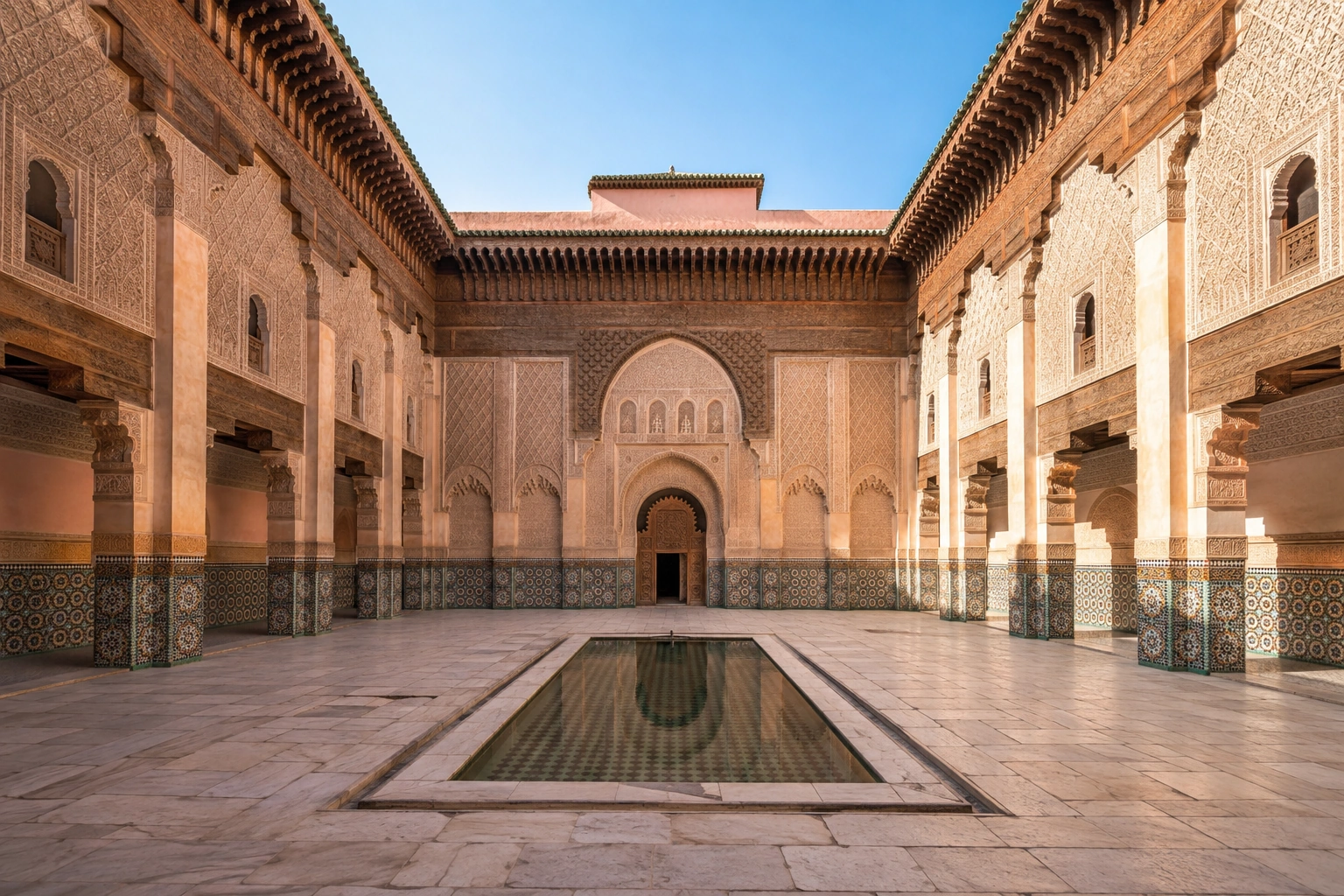
The official Ben Youssef Madrasa website identifies carved wood, zellige, and sculpted plaster among its architectural materials. At Ben Youssef Madrasa, choose one of those details to study before trying to include the whole courtyard. A close photograph can preserve a pattern that disappears in a wide portrait.
For the personal image, leave some quieter space around the face. A highly detailed surface can compete with an expression when it fills every part of the background. Try one frame with the person near the edge of the composition and one closer view. Review the difference together, then keep the version that best recalls being in the space.
Ask staff about visitor and photography arrangements for your plans, and consult the official site before arrival. Do not assume that online ticketing, every room, or a preferred position will be available. A reflection is an opportunity when conditions allow it, not a reason to lean over an edge or interfere with a water feature. The Experience Courtyard Reflection describes generated artwork, not a promised scene.
Keep the visit larger than the photo session
Before setting off, decide what would make the outing feel complete: a conversation in the square, time with the palace details, or a portrait with a companion. That choice gives you a stopping point. Once you have a scene image and a personal image you like, put the phone away long enough to notice something you did not plan to photograph.
The Marrakech collection has seven supported Landmarks, each requiring its own successful Unlock. Complete the current location check inside the relevant supported area and confirm success before leaving. Afterwards, choose a curated Experience and use your reference photos to create a private generated Memory. The first GPS unlock grants one welcome credit once per account, rather than another credit at every stop.
Keep the camera images as your record of the real conditions. A generated Memory can sit beside them as a creative interpretation, clearly identified when shared. For an outing built around plants and open water, the Majorelle and Menara photo guide helps you choose between two different garden settings.
Useful details
Frequently asked questions
Is this a timed walking route through Marrakech?
No. These are choices for a photo outing, not a tested route or a promise that all five stops fit in one day. Use a current map, venue information, and your group’s needs to select the stops.
Does a Koutoubia Experience provide mosque access?
No. The Koutoubia photo ideas use permitted exterior positions. An app unlock does not grant mosque entry, a tower climb, or a private session; follow the site’s visitor boundaries and directions.
Can I create a Marrakech Memory after leaving Morocco?
Yes, after you have successfully unlocked that Landmark inside its supported area during the visit. The unlock persists for later Memory creation, but an old photograph cannot replace a missing location check.
Source notes
Sources
This article was prepared with editorial automation using the source pack below.
- Marrakech Landmarks and ExperiencesUnlocked
- Marrakech medina and KoutoubiaMoroccan National Tourist Office
- Ben Youssef Madrasa visitor informationMinistry of Habous and Islamic Affairs
- Discovering the history of MarrakechMarrakech-Safi Regional Tourism Council
- Woodcraft and the El Badi settingMarrakech-Safi Regional Tourism Council