A first Chongqing visit usually begins with a list: Hongyadong, Jiefangbei, Liziba, Ciqikou, Chaotianmen, the Great Hall, the Huguang Guild Hall. The list is not the problem. The problem is that the list says nothing about which of these places belong on the same day, and in a city built against a hillside, that decision decides whether the trip feels composed or like a commute you chose voluntarily.
This is a grouping guide, not a timed itinerary. It draws on the Unlocked Chongqing collection, the published walking track, and public sources about the city’s terrain. It promises no walking durations, transit times, or current access conditions; check those for your own dates.
Start with the terrain, not the map
iChongqing’s Mountain City guide describes Chongqing as a city where “the mountains and the rivers have become a part of the city’s infrastructure,” with layered ground that makes some buildings appear taller simply because they sit higher. The practical consequence for planning: two points that nearly touch on a map can sit at different levels, and the connection between them may be a slope, a stairway, or a longer detour than the map suggests.
So group by district and by level changes, not by raw distance. Ask of any two stops: are they in the same district, and does getting between them involve climbing? If the answer to the second question is yes, treat the pair as a bigger commitment than it looks.
One strong day: the riverside five
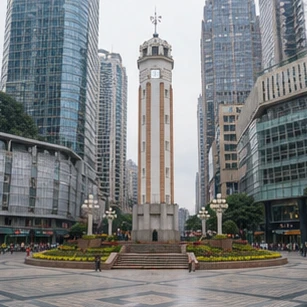
Five of the seven Landmarks sit close enough to share a day, and the published Vertical City: River to Rail track already strings them in a workable order: Chaotianmen, Hongyadong, Jiefangbei, the Great Hall, and Liziba.
The order earns its shape. Chaotianmen gives you the confluence’s open space first, when your attention is fresh. Hongyadong then trades that openness for layered galleries. Jiefangbei adds the pedestrian core, the Great Hall resets the scale to something formal and calm, and the train through the building at Liziba ends the day on movement. A local riverfront report from April 2026 describes a pedestrian connection between Hongyadong and Chaotianmen Square; treat that as context and recheck the current path on the day.
Be honest about the tradeoff: five stops is a full day, and the track’s per-stop time suggestions are editorial, not measured for your pace. If your group slows in the afternoon, drop the Great Hall to a shorter stop or move Liziba to another day. A composed four beats a rushed five.
Give Ciqikou its own half-day
Ciqikou Ancient Town is the one Landmark that punishes being bolted onto a peninsula day. It sits in Shapingba district, reachable on Line 1 according to iChongqing’s visitor page, and it is a riverside old town of stone lanes rather than a single viewpoint. Rushing it between two closer stops converts the town’s main pleasure, wandering, into a corridor.
Plan it as a half-day with a recoverable shape: arrive, turn off the main street early, let the lanes narrow, and leave when the crowds or your feet decide. The dedicated Ciqikou visit guide covers the lane tactics and the teahouse etiquette in detail.
The quiet hour: Huguang Guild Hall
The Huguang Guild Hall is the collection’s counterpoint and the easiest Landmark to under-plan. Ochre walls, carved timber, and courtyards near the Yangtze waterfront give it soft, indirect light and a slower register than anywhere else on the list. An unhurried hour covers the courtyards; it pairs naturally with a riverfront walk in the same afternoon rather than with the track’s busiest stretch.
If your visit is short, this is the Landmark to protect when other plans collapse, precisely because it asks so little of the schedule.
Keep one evening loose
Do not fill every night with transfers. The pedestrian core around Jiefangbei is described by iChongqing as an attractive place at night, and Hongyadong’s eaves change character when lit. One unhurried evening in this core, with the river somewhere in the walk, rewards you more than a second daytime sprint. The after-dark planning guide separates the night views worth chasing in person from the ones a generated Memory can interpret later.
A caution that also appears in our other Chongqing guides: the famous far lookouts, across the river or up on Nanshan, are separate places. They are photographs, not arrival areas. No Unlocked Landmark is verified from a viewing deck on the far bank.
What the app needs from each day
Unlocked verifies presence, one Landmark at a time. Open the Landmark, choose Unlock while inside its supported area, and confirm success before moving on. The check for Hongyadong does not cover Chaotianmen or Liziba; each place keeps its own record. Your first GPS unlock grants one welcome credit once per account, and every verified unlock stays attached for later.
That last point shapes the whole week: the app does not need you to finish anything on site. Do the visit, confirm the unlock, put the phone away. The Hongyadong and Chaotianmen photo guide and the Liziba monorail guide cover the picture-making; Memories can wait for the hotel room. And if the forecast turns grey, read the fog-day plan before you rebook anything: in this city, grey is part of the identity, not a failure of the trip.
Useful details
Frequently asked questions
Can I visit all seven Chongqing Landmarks in one day?
The collection is geographically concentrated, but quality drops when every stop competes for the same hours. A walking-track day covers five Landmarks, and Ciqikou sits in another district on Line 1. This guide promises no transit times; check current connections for your dates.
Does Unlocked plan my route between the Landmarks?
No. The app verifies presence inside each Landmark's supported arrival area. The published Chongqing track offers one suggested order, but transport, timing, and access checks remain yours to arrange with current local information.
Do I have to unlock all seven Landmarks?
No. The collection is a menu, not a checklist. Unlock the places you actually visit; each check happens inside that Landmark's supported area, and earned unlocks stay attached to your account for later Memory creation.
Source notes
Sources
This article was prepared with editorial automation using the source pack below.