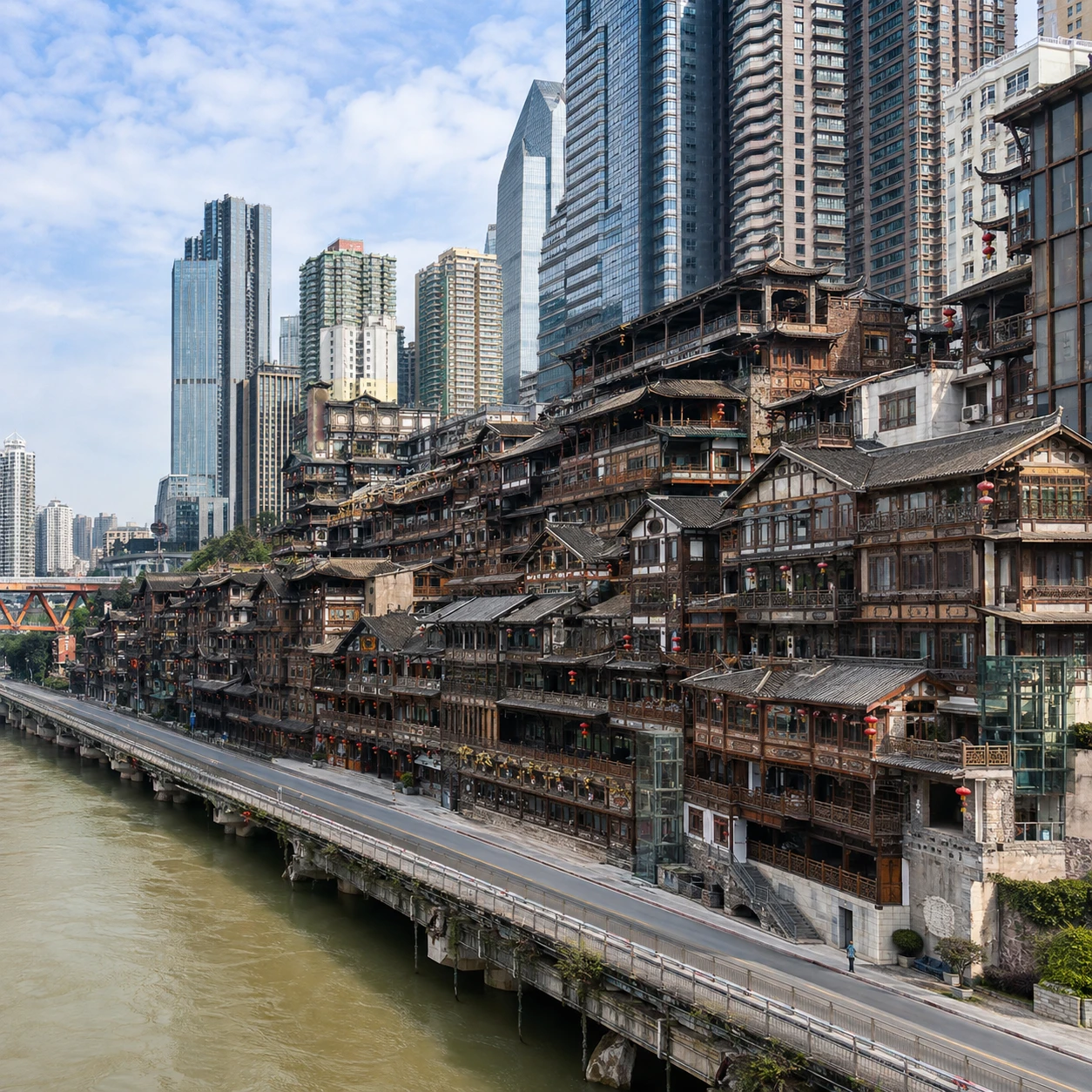
Hongyadong and Chaotianmen photos work as a pair when you let them describe different parts of Chongqing. Hongyadong supplies the layers: eaves, galleries, and buildings against the hillside. Chaotianmen supplies the space: water, sky, and the skyline around the river confluence. A portrait can belong in both settings without using the same framing twice.
Start by deciding what you want to remember at each stop. If the answer is the scale of the city, keep a wide frame. If it is being there with someone, make a closer portrait too. This is a set of photo-planning choices based on the places and their visitor context, rather than a timed itinerary or a firsthand report of today’s conditions.
Choose the approach as carefully as the viewpoint
A pin on a map gives you a destination, but it may not explain which pedestrian level reaches it. Before setting off, look at the approach, the place you want to stop, and the return connection. In a city built across steep terrain, a short distance on the screen can leave a change of level unresolved.
iChongqing’s April 2026 riverfront report describes a pedestrian connection between Hongyadong and Chaotianmen Square. Use that as background for planning, then check the current path and local directions. A dated route description cannot establish that every entrance or section is available during your visit.
Decide whether the connection suits everyone in your group before promising two stops in one outing. If one person wants a longer photo session and another needs a shorter walk, keep the second stop flexible. You can put the two photographs together later even if you make them on different days.
Let Hongyadong’s layers explain the city
At Hongyadong, try a scene photograph that gives the galleries and the riverfront a clear relationship. The local tourism description identifies its multilevel, stilt-style architecture. Choose how much of that structure you need to show rather than squeezing every visible building into the same frame.
Then make a portrait with a smaller area of background. Bring the person closer and keep a recognizable run of eaves or galleries behind them. Look for the edge that matters most: the roofline, a balcony, or the line between the buildings and sky. Keeping one of those clear often tells the story better than showing all of them equally.
If the lights are on, check the person as well as the architecture on your screen. A photograph that holds the bright eaves may leave a face too dark for the portrait you wanted. Keep the illuminated scene as one image, then adjust the portrait’s framing or position within the available visitor space. You do not need one exposure to carry both jobs.
Change scale at Chaotianmen
At Chaotianmen, give the water enough room to explain why you came to the confluence. Look at the horizon before pressing the shutter. Decide whether the skyline should feel dominant or sit above a broad foreground of river. Both can work, but they tell different stories.
For a personal photograph, avoid pushing the person toward an edge just to make the background larger. Bring the camera and person closer together within a permitted place to stop. Check where a railing crosses the frame and whether a tower seems to grow out of the person’s head. A small change in crop can solve either problem without moving beyond a barrier.
Be precise about the destination name. This Landmark’s supported arrival area is around the confluence square; Chaotianmen Bridge, the metro station, and a view from another bank are separate locations. Confirm the square in your route planning and the Landmark in the app. Sharing a familiar name does not make every viewpoint the same place.
Give a companion a repeatable photo request
Agree on one scene photograph and one portrait at each stop. Before handing over a phone, show the framing you have in mind. An illustrative request for Hongyadong is: “Keep those roof layers above me, but bring me closer than in the wide picture.” At Chaotianmen, it might be: “Leave some river beside me and keep the horizon level.”
Ask for a short set, then look at the expression, the edges, and whether the place is recognizable. If one important element is missing, describe a single adjustment. Changing the pose, camera height, crop, and background at once makes it hard for a willing helper to understand what you want.
Afterward, swap roles or put the phone away. Leave paths and busy stopping points clear while you review the images. A usable portrait gives you permission to enjoy the rest of the visit; you can notice another moment later without turning the whole outing into a sequence of camera positions.
Keep the conditions in the story
Your camera photographs can show the Chongqing you encountered: the crowd, the visibility, the river surface, and whatever light was present. If the skyline is hazy, a closer composition may hold your attention better. If the river occupies more of the view than you expected, let its open space become part of the picture.
A reference photograph is useful for understanding a composition, but it cannot tell you that today’s lighting, water appearance, or access will match. In particular, do not build the whole visit around finding a sharp color boundary between the two rivers. Keep the view you actually see, and choose another subject if that detail is absent.
Select the pair together afterward. A dense Hongyadong frame and a spacious Chaotianmen portrait can complement each other precisely because they do not look alike. The difference preserves something about the two visits that a matching pose and crop might flatten.
Verify each visit before creating a Memory
The Chongqing collection contains seven Landmarks, each with its own location check. Open Hongyadong or Chaotianmen in the app, choose Unlock while in its supported area, and confirm success before leaving. Seeing the place from a distant viewpoint does not substitute for that check. Respect any restriction that prevents reaching a permitted arrival position.
Hongyadong offers Lantern Evening, Riverfront Morning, and Mountain City Cinema. Chaotianmen offers Two Rivers, Skyline Blue Hour, and River Breeze. These names describe generated creative directions, not reserved viewpoints or forecasts. Once you have unlocked a Landmark, you can select reference photos and create a private Memory later.
Keep that interpretation alongside the camera record and identify it as generated when sharing. If the train-through-building scene is next on your list, the Liziba monorail photo guide explains how to give movement and a personal portrait separate attention.
Useful details
Frequently asked questions
Is this a timed walking route between Hongyadong and Chaotianmen?
No. The guide offers photo and planning choices around two places. A local tourism report describes a riverfront connection, but you should check the current route, access conditions, and suitability for your group.
Will I see different colors where the two rivers meet?
Do not plan around a guaranteed color division. Photograph the confluence as you encounter it; the Two Rivers Experience is a generated interpretation rather than evidence of water conditions.
Can one location check unlock both Landmarks?
No. Hongyadong and Chaotianmen each require a successful check inside their own supported area. Confirm both unlocks during permitted visits, then create your private Memories later if you prefer.
Source notes
Sources
This article was prepared with editorial automation using the source pack below.