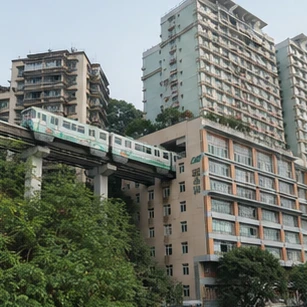
Liziba monorail photos have a timing problem and a storytelling problem. The train moves through the frame, but the building is what makes that movement distinctive. A close crop of the train can lose the relationship you came to see. A wide frame can explain the scene while leaving the person almost invisible.
Give yourself two pictures to solve those problems: one that shows the train and building together, and another that includes you clearly. You can make both during the same visit without asking every passing train to deliver a perfect portrait. The suggestions here are planning advice, with local source links for place context; they do not establish current service intervals or platform conditions.
Start from the viewing area
iChongqing describes Liziba as a Line 2 station where the monorail passes through a building, with a viewing platform for watching the scene. Plan for that visitor area and follow current pedestrian directions. Photographing from the viewing area and riding the train offer different views of the same transport system.
Look at the actual space before choosing where to stand. Keep the path behind you clear, notice where people enter and leave, and find a position where you can pause without making others walk around your equipment. The useful camera position is one you can occupy comfortably and appropriately while the scene unfolds.
A nearby hillside overlook may give a broad view, but it is a separate position. Do not assume it also lies in the app’s supported arrival area. If you want an Unlocked Experience, plan time at the Liziba Monorail Landmark itself and check the app there rather than relying on a distant photograph.
Compose before the movement begins
Point the camera at the building while there is no train in the frame. Leave the opening visible and enough of the surrounding structure to explain how the track relates to it. Look at the corners of your screen: a distracting sign or a cropped roofline is easier to notice before you are trying to capture movement.
Watch what happens before adjusting everything. If a train is too small in the frame, decide which part of the background you can remove while keeping the building legible. If it fills the picture without explaining the setting, widen the composition. The goal is a relationship between the moving subject and its surroundings, not simply a larger train.
Keep the first usable scene photograph even if it is not the final choice. Having that record reduces the pressure on the portrait afterward. You can also use a short video if movement is what you want to remember, then put the camera down to watch the scene directly.
Separate the train picture from the personal portrait
For the portrait, bring the person closer to the camera and decide where the train would sit relative to their head and shoulders. Avoid a composition that requires constant repositioning whenever someone passes through the visitor area. A recognizable building behind an ordinary expression can make a stronger personal photograph than an elaborate pose held for too long.
Give a helper one clear instruction before waiting. An illustrative request is: “Keep the building opening beside my shoulder and take a few frames when the train appears.” Show the intended crop first. That leaves the helper with a simple timing task instead of asking them to discover the composition at the same moment.
If the timing does not work, keep a portrait with the building and let your separate scene photograph carry the train. The two images can tell the whole story together. This is especially useful when traveling with someone who wants to watch rather than repeat a pose for every pass.
Choose how you want to show motion
A still photograph freezes a moment; a short clip shows the train entering or leaving the building. Decide which record you want before accumulating both by default. For a clip, hold a steady frame that already contains the relevant structure, and allow the movement to happen within it rather than continually chasing the train with the phone.
For a still, a short sequence can help you compare positions afterward if your camera offers that option. Review whether the train is readable and whether the relationship to the building is clear. A technically sharp frame is not automatically the best explanation of the place if the important part of the structure is hidden.
Keep edits modest when selecting your camera record. Cropping can strengthen the composition, but it cannot recover a section of the building that was never in the frame. Choose an image that preserves the reason Liziba interested you, even if another picture has a cleaner sky or fewer people.
Leave room for the everyday city
Liziba is also a working transport location beside homes. Use the visitor space without treating adjoining residences or transit areas as extra camera positions. A preview with a dramatic angle does not grant access to a balcony, rooftop, or restricted part of the railway.
Decide when you have enough. A scene image, a portrait, and perhaps a short clip can be a complete set. If the viewing area feels too busy for another attempt, simplify the picture or pause elsewhere where stopping is permitted. There is no need to hold a place indefinitely just because the train will pass again.
For a different photographic rhythm, the Hongyadong and Chaotianmen guide focuses on layered architecture and open river views. Use current route information when deciding whether to combine these visits. The guide names places to consider, rather than promising a fixed connection or transit time between them.
Confirm the unlock while you are there
Open Liziba Monorail in Unlocked and complete its location check inside the supported arrival area around the public viewing area. Confirm that Unlock succeeds before leaving. Do not rely on riding past in a train, and do not assume the whole neighborhood or every viewpoint is included.
After the visit is verified, choose Train Through the City, Hillside Layers, or Transit on Film to create a private generated Memory. These Experiences interpret the place; they do not prove that a particular train was passing at the instant you unlocked. Your camera photograph or video is the record of the movement you watched.
The Chongqing collection keeps each Landmark separate, and a successful unlock remains available for later Memory creation. Your first GPS unlock grants one welcome credit once per account. You can take time choosing reference photos afterward instead of making the viewing platform the place where you finish every part of the process.
Useful details
Frequently asked questions
Do I need to ride the train to take the famous building photograph?
The viewing area and a train ride offer different perspectives. Choose the public viewing area for the exterior relationship between train and building, and arrange any rail journey separately through current transit information.
How often does a train pass at Liziba?
This guide does not provide a service interval. Check current transit information for your visit, then prepare your composition before movement enters the frame rather than relying on a promised wait time.
Does Train Through the City record the train I watched?
No. It creates a generated interpretation after your Landmark visit is verified. Keep your camera photo or video as the record of the particular train and conditions you actually saw.
Source notes
Sources
This article was prepared with editorial automation using the source pack below.
- Chongqing Landmarks and ExperiencesUnlocked
- Liziba and its viewing platformiChongqing