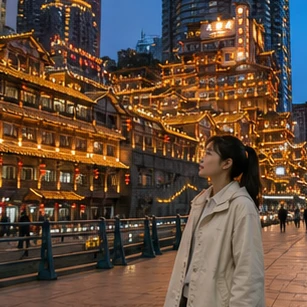
Chongqing at night mixes two questions that travelers tend to fuse: where should I physically stand this evening, and what will my night Memory require? The answers are different. The first depends on lighting, crowds, and how many level changes your legs have left. The second depends on nothing but a verified unlock, because Unlocked’s night-direction Experiences are generated interpretations, not records of any particular evening.
Separating those two questions is the whole planning trick. This guide draws on iChongqing’s night-viewing page and the Unlocked catalog; it is advice, not a firsthand survey, and it promises no schedules.
What night actually changes at each Landmark
Not every Landmark earns an evening slot. Three do. Chaotianmen is where iChongqing anchors its night coverage: the square stands at the junction of the Yangtze and Jialing rivers, and the page calls a river cruise the most natural way to take in the skyline, with options from affordable to luxury. Hongyadong changes register entirely when its eaves are lit, and Jiefangbei’s pedestrian core is described by iChongqing as an attraction in its own right at night, with the district’s screens turning the streets into a canyon of light.
Elsewhere the payoff is smaller after dark. Ciqikou’s lantern hours reward a late-afternoon arrival more than a late one, and the Great Hall’s floodlit dome is a different photograph from its daytime form, but a single viewing pass suffices.
The viewpoints that are not the Landmarks
iChongqing’s night-viewing page rightfully celebrates the far side: Nanshan’s lookouts, the parks along Nanbin Road, and the Yangtze cableway crossing, which the page describes with its listed length and fares as a paid return journey. Plan these as what they are, magnificent photograph positions, and keep them out of your unlock plans.
The rule the app enforces is simple: presence is verified inside each Landmark’s supported arrival area, never from a deck, a cable car, or the opposite bank. An evening that runs Hongyadong, the walk to Chaotianmen, and one far-bank viewpoint produces two legitimate unlocks and one beautiful photograph, in that order.
Treat every lighting window as dated
The night-viewing page describes seasonal evening windows for the illuminated skyline. Our editorial rule, consistent across every Chongqing guide we publish, is that such windows are context, not promises: illumination arrangements change, and a page’s described hours cannot guarantee what will be lit on your Tuesday. Confirm locally, and hold the plan loosely.
The same discipline applies to cruises and the cableway: prices and arrangements listed on a dated page are starting points for your own check, not terms we reproduce as current.
Night Memories do not need night visits
Here is the part that surprises people. Lantern Evening at Hongyadong, City Lights at Jiefangbei, and Skyline Blue Hour at Chaotianmen sound like appointments. They are not. Each is a generated creative direction attached to its Landmark, available after any verified unlock, at any hour, on any later day. Complete the location check during a permitted visit, and the evening interpretation can be created from your hotel room the following morning.
The division of labor that follows is clean. Your camera photographs are the documentary record of the night you actually had, the crowd, the haze, the lights as they were. The generated Memory is an interpretation, and should be identified as generated when shared. If you want both, earn the unlock in person and make the picture twice: once with the camera at the place, once with the Experience afterward. The photo-pairing approach in our Hongyadong guide applies at night unchanged.
An evening shape that respects the walk
Illustrative evening plan, not a timed route: start at dusk at Chaotianmen while the sky still holds some blue, follow the riverside toward Hongyadong as the eaves come on, then climb into the Jiefangbei core for the screens and a late dinner. The April 2026 riverfront report describes a pedestrian connection along this stretch; recheck the current path and its level changes before committing the group to it.
If the evening collapses, one of the three stops still makes a complete night. Do not convert a flexible walk into a checklist; the first-visit grouping guide explains why one loose evening outperforms a second sprint.
When the night disappears into weather
Chongqing’s fog does not observe the evening schedule. If the skyline dissolves, the plan survives: the unlock is verified by presence, not visibility, and the close-range stops, Hongyadong’s galleries, the Jiefangbei screens, hold up in grey air better than any far view. The grey-day plan covers the full adjustment, including which Landmarks to keep and which to trade away.
Useful details
Frequently asked questions
Are Chongqing's lighting times guaranteed?
No. iChongqing's night-viewing page describes seasonal evening windows for the lit skyline, but a dated description is not a schedule for your visit. Check locally on the day; nothing in Unlocked depends on the lights being on.
Can I unlock a Landmark from a night viewpoint like Nanshan or the cableway?
No. Distant lookouts, the cableway, and the far riverbank are separate places. Each Landmark's location check happens inside its own supported arrival area, and a view across the water does not substitute for standing there.
Do night-named Experiences require an evening unlock?
No. Lantern Evening, City Lights, and Skyline Blue Hour are generated creative directions. Complete the physical-presence unlock at any permitted hour, then create the Memory later; your own night photographs remain the record of the evening you actually had.
Source notes
Sources
This article was prepared with editorial automation using the source pack below.
- Night viewing in ChongqingiChongqing
- Jiefangbei pedestrian districtiChongqing
- Chongqing Landmarks and ExperiencesUnlocked