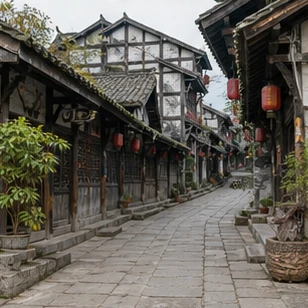
Ciqikou rewards visitors who arrive with the right expectation: this is a living old town on the Jialing riverside, extremely popular, and still generous to anyone willing to leave its main street. The disappointment pattern is predictable, and avoidable: a visitor arrives at peak hours, walks the busiest lane in both directions, photographs the same snack stalls as everyone else, and leaves believing the town is only its crowd.
This guide is a set of planning decisions drawn from the Unlocked catalog and iChongqing’s Ciqikou visitor page. It is not a firsthand crowd survey, and no quiet hour or transport time is promised.
Know what the town actually is
iChongqing traces Ciqikou to a Song-dynasty village that became a trading wharf, famous for chinaware in the Ming dynasty; the name translates to a gateway for porcelain. The page identifies its cultural anchors as a traditional Sichuan Opera stage, an old tea house, and the water gate, and notes the town has been nicknamed “Little Chongqing” for the role it played in the city’s river trade.
That history explains the layout you will actually walk: stone lanes climbing from the river, timber storefronts, and working teahouses. It also explains the popularity. A place that served a city as its wharf does not stop drawing crowds once it becomes its memory.
The main street problem, and the uphill exit
The busiest lane is the main street. Our editorial guidance is blunt: turn uphill early. The side alleys keep the old texture, stone, timber, and lantern lines, with a fraction of the visitors, and the crowd thins as you climb. The main street is worth one pass to understand the town’s energy, not repeated laps looking for a gap that will not open.
Incorrect example: planning the visit as “arrive at the main entrance, follow the crowd, exit the way you came.” That route guarantees the maximum number of people in every frame and misses the lanes that make Ciqikou worth the trip.
Correct principle: enter, orient, then leave the main axis within the first stretch and let the hillside decide the route. If a lane dead-ends, the detour is usually short and quieter than where you started.
Mornings, weekdays, and the temple fair
Timing advice has to be honest about its limits: we do not promise a quiet slot, because the town’s popularity varies with seasons, holidays, and weather. As editorial guidance, weekday mornings are the calmest stretch, and midday weekends are the busiest. The iChongqing listing’s own transport section, Line 1 to Ciqikou station, plus several bus routes, exists precisely because the town draws heavy visitation.
One dated event changes the crowd math entirely: the Ciqikou temple fair. iChongqing describes it as a folk-culture event integrating performances, beliefs, and trade, most prominent around Spring Festival and the Lantern Festival, with the first such fair held in 2001. If your visit lands in that window, expect lanterns, drummers, and dense crowds, and decide in advance whether that density is the version of Ciqikou you want.
Teahouse manners for photographers
The teahouses are businesses, not sets. Keep doorways and seating clear, buy something if you occupy a table, and ask before photographing staff or guests at close range. The same applies to the opera stage and any performance: watch first, photograph second, and never position equipment where it interrupts the room’s actual work.
A portrait in a teahouse doorway can work beautifully; it works best when the doorway’s owners have agreed to it. If permission feels awkward, move one lane over and use the architecture alone.
Getting there and pairing it
Ciqikou sits in Shapingba district, and per iChongqing’s transport notes it is reached on Line 1 or by bus to the main entrance. That district placement is the planning point: this is not a stop between peninsula landmarks. Give it a half-day with a recoverable shape, an unhurried arrival, a lane wander, a teahouse pause, and a departure that does not need to race anything. Our first-visit grouping guide places it accordingly.
The unlock and the three Experiences
The Ciqikou Landmark verifies presence inside its supported area across the old town’s lanes. Open the Landmark in the app, choose Unlock while inside the boundary, and confirm success before leaving. A view from the river side or a photograph from a passing bridge does not substitute for that check.
Afterward, three Experiences interpret the place: Old Lane Morning, Teahouse Light, and Stone and Lanterns. Their names are creative directions, not schedules or reservations. You can unlock at 4 p.m. on a drizzling Tuesday and still create the morning-lane Memory later, because the unlock records where you were, not the mood you were promised. Your camera photographs remain the documentary record of the lanes as you met them; the generated Memory is an interpretation, and should be identified as one when you share it.
If the rest of the week fills up, read the grey-day plan: Ciqikou’s close textures are exactly the kind of place that carries a visit when the skyline disappears.
Useful details
Frequently asked questions
Is entry to Ciqikou Ancient Town free?
The iChongqing listing describes free entry to the town, with teahouses and shows setting their own prices. Confirm current arrangements locally; individual venues and events can change their terms independently of the town.
When is Ciqikou quiet?
No guaranteed quiet slot is promised here. As editorial guidance, weekday mornings are the calmest stretch and the main street is busiest on weekend afternoons; side lanes thin out at every hour.
Does the Teahouse Light Experience include a teahouse?
No. Its name describes a generated creative direction shaped by warm wood and doorway light. Teahouse seating is arranged with the venue separately, and the Memory is created after your verified visit.
Source notes
Sources
This article was prepared with editorial automation using the source pack below.
- Ciqikou Ancient Town visitor pageiChongqing
- Chongqing Landmarks and ExperiencesUnlocked