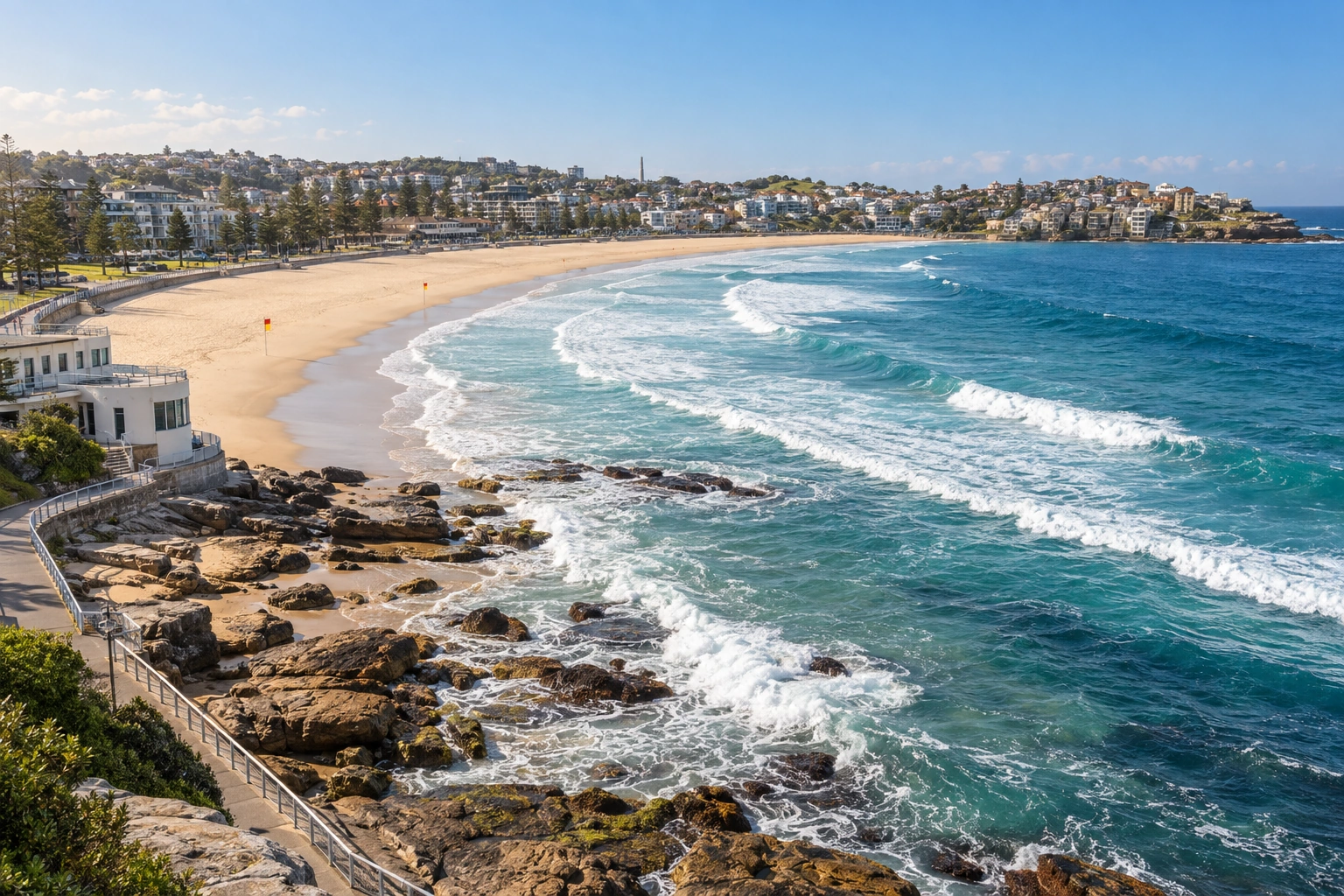
Sydney’s postcards are blue-sky postcards, and that is exactly the trap. The city’s most visit-planning-relevant weather facts are two things no northern-hemisphere visitor adequately prices in: a sun that reaches the extreme UV band on ordinary warm-season days, and a wind change that can end a 35-degree afternoon inside an hour. Neither is a footnote. Both should shape the day before you leave the hotel.
This is a condition guide, not a forecast. It draws on ARPANSA’s UV guidance, Cancer Council’s UV index page, the Bureau of Meteorology’s explainer on southerly busters, and Waverley Council’s beach safety page, checked in October 2026. No month-by-month tables and no weather promises; check the forecast and the daily UV protection times for your own dates.
The UV reality: protection at 3, not at noon
Australia’s radiation authority is blunt about the threshold: sun protection is recommended whenever the UV index reaches 3, and the Bureau of Meteorology issues forecast sun protection times daily. In Sydney’s warm months the index does not creep past 3 — it climbs to the very-high and extreme bands, above 8 and above 10, around the middle of the day. The visitor version of this: the burn happens between breakfast and lunch, not because the sun feels fierce at nine in the morning but because the index is already there while the air still feels mild.
Incorrect example: applying sunscreen at the beach and nowhere else. The collection’s daylight checks are almost all open-air walks — the Opera House podium, the Royal Botanic Garden shore, the Bradfield Park lawn, the Bondi promenade — and the harbour adds glare off the water to the direct index. Correct principle: hat, SPF50+, and sunglasses from the morning, shade breaks built into the walking, and the daily protection times checked with breakfast like a tide chart.
The southerly buster: the day’s second act
The southerly buster is the most Sydney weather event there is, and the Bureau of Meteorology documents it precisely: on hot afternoons or evenings, a strong southerly change sweeps up the NSW coast, and the temperature can fall 10–15°C inside an hour along the change front, with gusts and often a dramatic sky. For a visitor mid-Sydney-day it arrives as relief and disruption at once — the walk finally breathes, and the hat, the beach umbrella, and every unsecured ferry napkin leave for the Tasman.
What it changes in practice, labeled as planning guidance rather than meteorology: carry a light layer even on the hottest day; expect ferries to pitch once the change arrives; and do not schedule the one indoor stop of the day for the hour the buster is forecast — the QVB is the collection’s natural midday anchor, but the buster’s own drama is worth watching from the harbour edge, not from inside a shopping arcade. The Bureau’s radar makes the change visible before it hits.
The day this produces
Put the two together and the Sydney day has an obvious shape. Open-air headlands early, while the index is still low and the light is long: Mrs Macquarie’s Chair before the garden’s noon crowd, or Bradfield Park under the arch with the whole harbour in front of you. Indoor or shaded stops through the UV peak — the QVB’s dome and clocks, an Opera House tour if you are buying one. The beach and the low-sun promenades after the angle drops: Bondi’s crescent in the late afternoon, when the sand stops radiating and the swim between the red-and-yellow flags — the patrolled zone Waverley Council’s lifeguards set daily — is at its best.
That ordering does double duty as a grouping strategy, which is the quiet reason Sydney rewards two or three days over one heroic loop: the geography groups cleanly, and the sun tells you which group goes where in the day.
What the app asks of a hot day
Nothing. The unlock verifies presence inside the supported arrival area and nothing else — not temperature, not wind, not the UV index. A check taken at Bondi in a 38-degree afternoon southerly counts exactly like one at dawn. The weather changes your plan, never your record.
The same honesty applies to the Experiences: they are generated creative directions available after a verified unlock, not weather records, and no Sydney Experience name promises a blue sky. A monochrome on-film portrait taken after a grey-morning unlock is not a compromised result — see when the photo is imperfect but the visit was real and, for the opposite city in every respect, the Chongqing fog-grey-days plan.
Finish the picture with the first-visit grouping guide, the Opera House visit plan, and the after-dark guide — and let the day’s actual UV times, not the postcards, set the order.
Useful details
Frequently asked questions
Does heat, glare, or wind affect my Landmark unlock?
No. The unlock verifies presence inside the supported arrival area and nothing else — not temperature, not UV, not the wind. A check taken on a 38-degree afternoon at Bondi counts exactly like one taken at dawn. The weather changes your plan, never your record.
What is a southerly buster?
A sudden strong southerly wind change that sweeps up the NSW coast on hot summer afternoons and evenings, with the Bureau of Meteorology documenting temperature falls of 10–15°C inside an hour along the change front. It is relief after a scorching afternoon and chaos for hats, umbrellas, and unsecured ferry decks — pack a layer even on the hottest day.
Should I swim at Bondi outside the flagged area?
No. Waverley Council's lifeguards assess conditions and set the red-and-yellow flagged zone daily; that is the patrolled water. If no flags are flying, swimming is not advised. The beach unlock works from the sand and promenade either way.
Source notes
Sources
This article was prepared with editorial automation using the source pack below.
- ARPANSA ultraviolet radiation guidanceARPANSA
- UV index and sun protectionCancer Council Australia
- The big bust: southerly busters explainedBureau of Meteorology
- Waverley Council beach safetyWaverley Council
- Sydney Landmarks and ExperiencesUnlocked