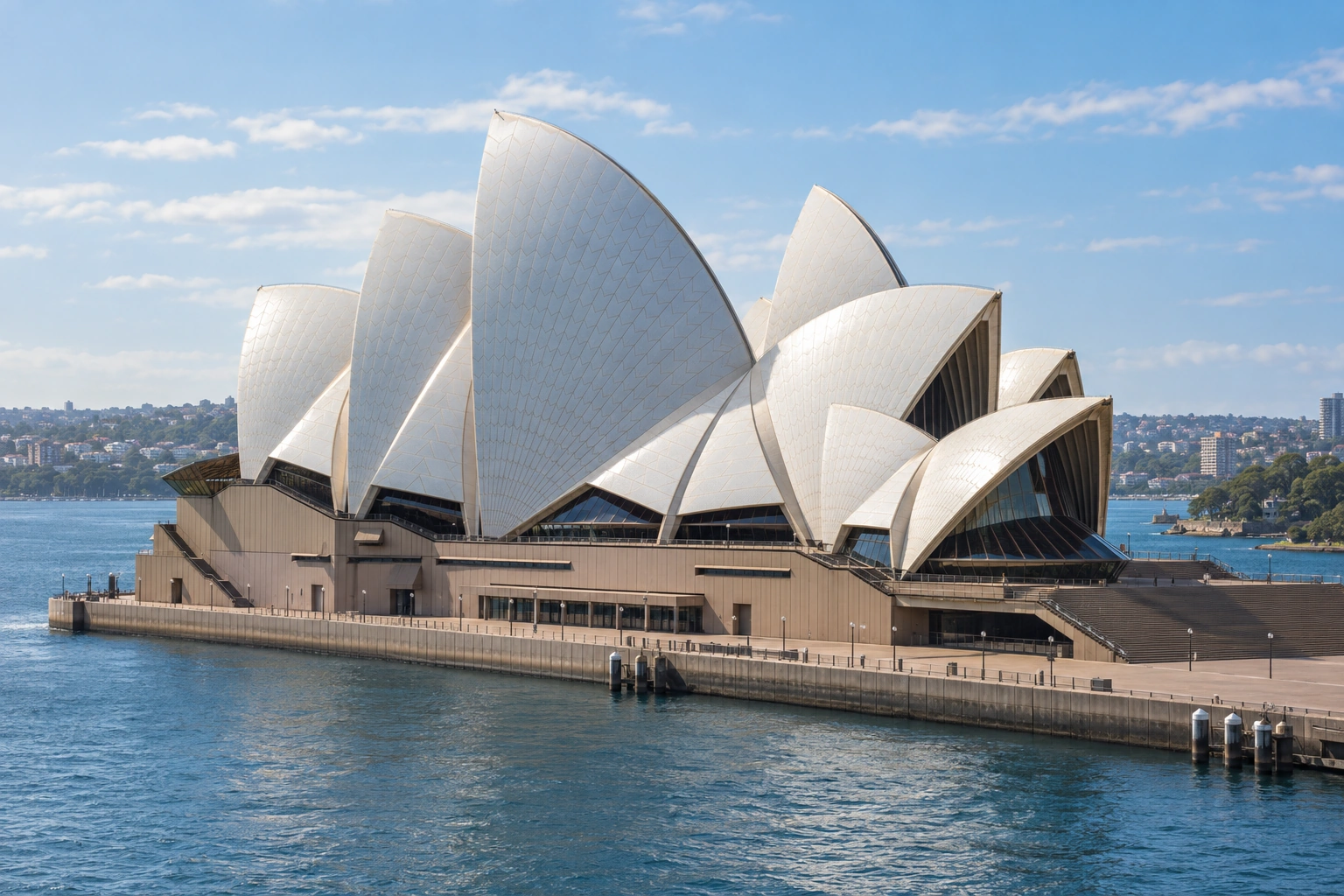
A first Sydney visit usually arrives with a list of icons: the sails, the arch, the beach. The list is not the problem. The problem is that Sydney is a drowned river valley with a harbour running through the middle of it, and a list says nothing about which of these places share a day, which one requires crossing the water, and which one is a bus route away entirely.
This is a grouping guide, not a timed itinerary. It draws on the Unlocked Sydney collection, UNESCO’s Opera House entry, the Royal Botanic Garden’s visitor page, and Transport for NSW, checked in October 2026. It promises no walking durations, queue lengths, or access guarantees; check those for your own dates.
Start with the water, not the list
Five of the seven Landmarks sit on the CBD side of the harbour, and the other two are the reason this guide exists. Straight-line distances computed from the catalog’s own coordinates tell the story: the Opera House to The Rocks is about 650 metres across the Circular Quay cove; the Opera House to Mrs Macquarie’s Chair about 740 metres along the garden’s shore; the Queen Victoria Building to Darling Harbour about 560 metres through the western end of the CBD. Those five are one walkable Sydney.
The other two break the pattern in opposite directions. The Sydney Harbour Bridge looks close — about 950 metres straight from the Opera House — but that line crosses open harbour water, because the bridge’s supported area is anchored at Bradfield Park in Milsons Point, under the arch on the north side. And Bondi Beach is about 6.8 kilometres east of the CBD cluster, on the ocean side of the headlands, past where the harbour geography stops helping you.
Incorrect example: planning the bridge unlock as a lunchtime detour because the map line looks short. Correct principle: the bridge check is a deliberate crossing with its own half-day — take the ferry from Circular Quay to Milsons Point or the train one stop, walk Bradfield Park, and look back at the skyline the way the postcards are shot.
One strong day: the Circular Quay three
The Opera House, The Rocks, and Mrs Macquarie’s Chair form one day with a natural arc. The Rocks’ sandstone lanes — Playfair and Argyle Streets under the bridge approaches, the 1840s–1870s terraces the catalog describes — work best in the morning before the quay fills. The Opera House podium takes the middle of the day; our Opera House visit plan covers the free-versus-ticketed split in detail. Mrs Macquarie’s Chair finishes the arc in the late afternoon, when the low sun sits behind the Opera House and the bridge in the same frame.
One constraint to plan around: Mrs Macquarie’s Chair sits inside the Royal Botanic Garden, which is free to enter but closes at sunset, with seasonal closing times published by the garden. It is the collection’s one Landmark with a gate on it. If your day runs long, the chair is the check that slips to tomorrow — see the after-dark guide for what that leaves you in the evening.
The three checks are separate. The presence check at the Opera House podium does not cover the Rocks or the chair; each Landmark keeps its own record, and each supported area is its own arrival.
The western pair: QVB and Darling Harbour
The Queen Victoria Building and Darling Harbour make a natural second morning: two stops, about 560 metres apart, on the CBD’s western slope. The QVB is George McRae’s Romanesque Revival market hall of 1893–1898 — sandstone arcades, turrets, and a central glass dome filling the George-to-York block — and it is an indoor stop, which matters more in Sydney than most visitors expect; our sun-day plan gives it the noon slot. Entry is free and trading hours are published on the QVB’s own site, with a late night one evening a week and shorter Sunday hours, so verify for your date.
Darling Harbour adds the working piece of engineering: the 1902 Pyrmont Bridge, one of the world’s oldest surviving electrically operated swing spans, which still swings on a limited schedule for vessel passage — a possibility to catch, not a show to schedule. The waterfront promenade itself is public and free at any hour, which makes this the collection’s easiest evening-compatible stop.
The two outliers, taken seriously
Treat the bridge and Bondi as one leg each, not as add-ons. The bridge day is a harbour crossing: ferry from Circular Quay or the T1 train to Milsons Point, the unlock at Bradfield Park under the arch, and if you want the height, the south-east pylon reopened as the ticketed BridgeMuseum in May 2026, with its lookout level 87 metres above the water reached by about two hundred steps. Crossing on foot along the walkway is free around the clock; the climb and the pylon are separate ticketed products.
Bondi is its own half-day at minimum. The route 333 bus links the quay with North Bondi via Bondi Junction, and the one-kilometre crescent between Ben Buckler and McKenzie’s Points — with the surf lifesaving club founded in 1907 at its southern end — rewards an hour or three. If the ocean pool-and-cliff path tempts you onward, the Bondi-to-Coogee coastal walk runs about six kilometres; that is a separate trip from any unlock, and the beach check happens on the sand and promenade, not from a headland on the way to Coogee.
What the collection does not include
Three names come up in every Sydney conversation and none of them are in the collection: Manly, Taronga Zoo, and the Blue Mountains. The city page says so plainly, and it is worth internalizing before you build a day around a check that does not exist. A ferry to Manly is a fine Sydney afternoon; it just is not an Unlocked Sydney afternoon. Same for the mountains, which are a full-day drive west.
What the app needs from each day
Unlocked verifies presence, one Landmark at a time. Open the Landmark, choose Unlock while inside its supported area, and confirm success before moving on — the check at Bradfield Park does not fire from the Opera House side, and the check on the sand does not fire from the bus. Your first GPS unlock grants one welcome credit once per account, and every verified unlock stays attached for later Memory creation.
Two Sydney-specific notes. First, there is no published Unlocked walking track for this city yet — unlike Lisbon or Marrakech, the grouping above is yours to sequence, which is why this guide exists. Second, the water is not an obstacle to the app but it is an obstacle to your plan: a straight line across the harbour means a ferry timetable, so check Transport for NSW for the day you are there. The first-visit photo habits apply to all seven: do the visit, confirm the unlock, put the phone away.
For the detail behind the two biggest stops, continue with the Opera House visit plan and the after-dark guide; and before you pick your dates, read the sun, glare, and southerly plan — Sydney’s weather is the one thing on this list that changes daily.
Useful details
Frequently asked questions
Can I visit all seven Sydney Landmarks in one day?
Theoretically, and it would be a bad day. Five of the seven cluster around the CBD and quay, but the bridge check wants you at Bradfield Park across the harbour and Bondi is a bus route east, so the honest shape is two or three days with one crossing and one eastern leg. This guide promises no walking durations; recheck transport and access for your own dates.
Can I unlock the Harbour Bridge from the city side?
No. The bridge's supported area is anchored at Bradfield Park in Milsons Point, under the arch on the harbour's north side. The straight-line distance from the Opera House is under a kilometre, but it crosses open water. Take the ferry from Circular Quay or the train one stop — the crossing is the point.
Does Unlocked include Manly, Taronga Zoo, or the Blue Mountains?
No. The Sydney collection is the Opera House, the Harbour Bridge from Bradfield Park, The Rocks, Mrs Macquarie’s Chair, Darling Harbour, the Queen Victoria Building, and Bondi Beach. Manly, Taronga, and the Blue Mountains are separate destinations outside the collection, however good they are.
Source notes
Sources
This article was prepared with editorial automation using the source pack below.
- Sydney Landmarks and ExperiencesUnlocked
- Sydney Opera HouseUNESCO World Heritage Centre
- Royal Botanic Garden Sydney visitor informationBotanic Gardens of Sydney
- Transport for NSW trip planningTransport for NSW