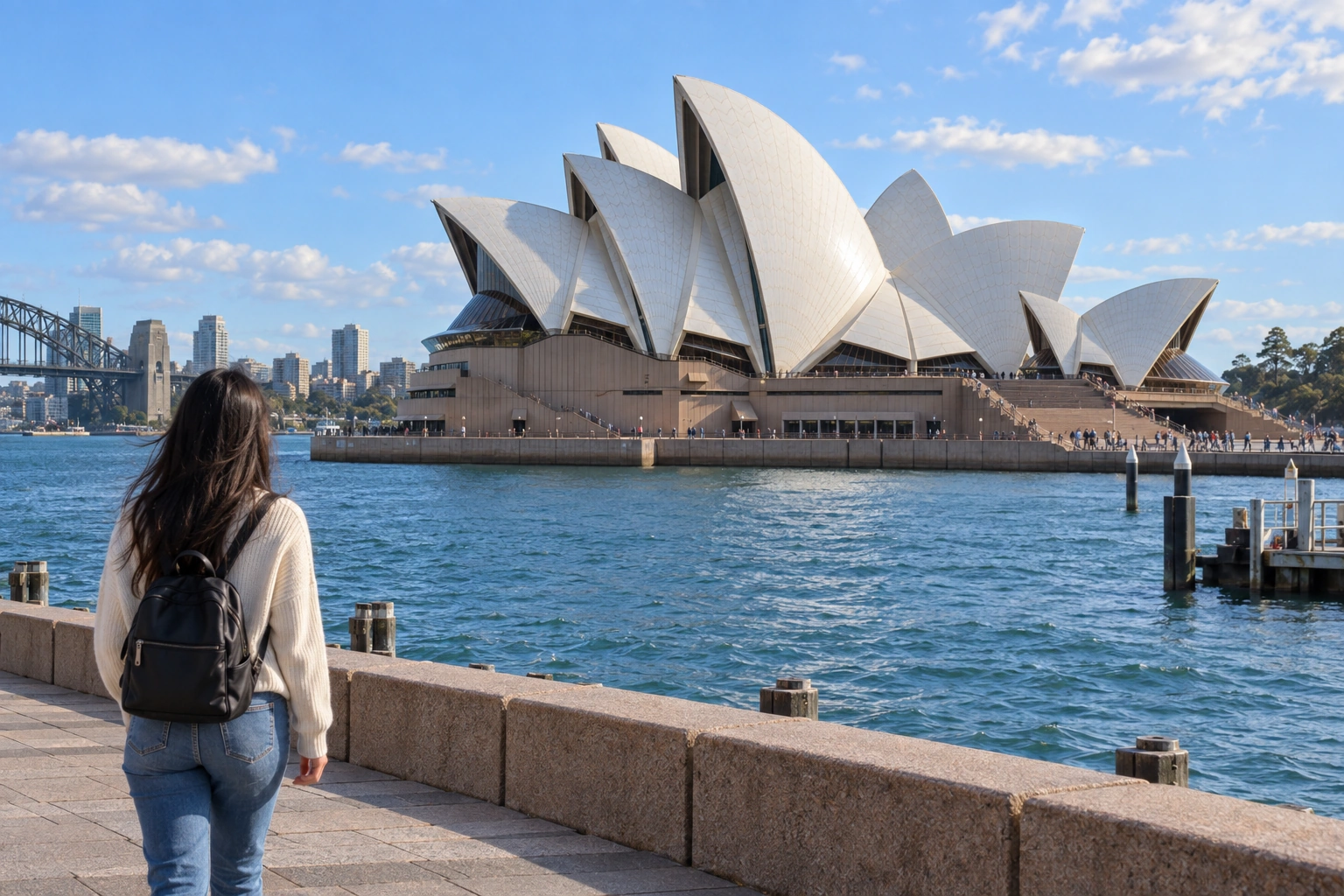
The Sydney Opera House is the rare world landmark where the best part is free, and most visit plans get that backwards. People budget for the tour, hurry the exterior, and leave feeling they saw the postcard of a building they never actually walked around. The building rewards the opposite order.
This visit plan splits the Opera House into what is public and what is ticketed, then covers how the Unlocked presence check fits, which is the same split in a different vocabulary. It draws on UNESCO’s World Heritage entry, the Opera House’s visit and tour pages, and the Unlocked Sydney collection, checked in October 2026. Tour prices and session times change; verify those on the official pages for your date.
Why the podium is the visit
UNESCO inscribed the Opera House in 2007 and describes it as a great architectural work of the twentieth century: Jørn Utzon won the 1957 international competition, the building was inaugurated in 1973, and the entry’s own language is about the interlocking vaulted shells rising above a vast podium whose terraces function as pedestrian concourses. That last phrase is the planning insight. The podium is not a fence around the monument — it is the monument’s public ground floor, wrapping Bennelong Point on three sides of the harbour.
What that means practically: the forecourt, the monumental steps, the lower concourses, the foyers, and the outside of every shell are open to the public without a ticket. What the ticket buys is the interiors — the concert halls and theatres — either through a guided tour of about an hour or through a performance ticket. The official tours page lists current options and prices.
Incorrect example: treating the forecourt photo as the visit and leaving. Correct principle: walk the full podium circuit. The chevron tiling of glossy white and matte cream reads differently from each side, the steps facing the harbour and the steps facing the quay are different experiences, and the shells’ geometry only resolves when you have been under all of it.
How the unlock fits the free visit
The Sydney Opera House Landmark verifies presence inside a supported arrival area around Bennelong Point. It does not verify a ticket, a tour, or an entry scan — the check is designed for exactly the free arrival described above.
Two mechanics worth stating plainly. First, plan the unlock on foot. The supported area is measured around the point itself; the ferries run past it and moor at Circular Quay, and a check attempted from a moving boat is a plan built on a maybe. Arrive at the podium, open the Landmark, choose Unlock, and confirm success before you drift on to the next thing. Second, the check is per Landmark: standing on the Opera House podium does not cover The Rocks across the cove, and it does not cover the bridge — that check lives at Bradfield Park, on the far shore. Your first GPS unlock grants one welcome credit once per account, and the Opera House check stands on its own.
If you want a record of the visit, the Landmark’s Experiences — Forecourt Daylight, Sail Shells, Opera House on Film — are generated creative directions available after a verified unlock, not photographs of a specific hour. The monochrome on-film portrait works as well after a grey-morning unlock as after a blue one. See seeing the landmark before the camera for the order of operations we suggest.
The view that completes it: Mrs Macquarie’s Chair
The one photograph the podium cannot give you is the one on every Sydney postcard: the sails and the arch in a single frame. That view comes from Mrs Macquarie’s Chair, the convict-carved sandstone bench of 1810–1811 on the Yurong Point ledge inside the Royal Botanic Garden, about 740 metres around the cove by straight line.
Treat it as a separate visit, because that is what it is: a separate Landmark with its own check, inside a garden that is free to enter but closes at sunset, with seasonal hours published by the garden. The arc that works is podium first, garden walk second, chair in the late light — at which point the first-visit grouping guide takes over for the rest of your days. For the evening half of the same point, the after-dark guide covers what happens on the podium after the garden gates close.
What a tour adds, and when it is worth it
Opinion, clearly labeled: the tour is worth it once, on your first visit, if the building’s construction story interests you — the engineering problem of those shells defeated the original schedule by years, and walking the venues explains why in a way no exterior can. It is not necessary for the unlock, not necessary for the photos, and skippable on a return visit or a short stay without any sense of loss.
If you do book, book ahead through the official site rather than third parties, and note that the check does not require it — a point that matters to anyone building a Sydney day on a budget. The building’s own framing is honest about the split: the shells and the podium belong to everyone, the auditoriums belong to ticket-holders, and the visit plan works at either price.
Useful details
Frequently asked questions
Do I need a tour ticket to unlock the Opera House in Unlocked?
No. The unlock verifies presence inside the supported arrival area around Bennelong Point; it is not a ticket check and it does not involve entering the venues. A tour is a fine way to see the interiors, but the check happens outside, in public space.
Where is the classic view of the Opera House with the Harbour Bridge?
Mrs Macquarie's Chair, on the Yurong Point ledge inside the Royal Botanic Garden, faces the harbour's postcard angle with the sails and the arch in one frame. It is its own Landmark with its own check, reached on foot around the cove, and the garden closes at sunset, so it is a daylight stop.
Can I unlock from the ferry as it passes?
We do not recommend planning it that way. The supported area is measured around the point itself, and the ferries moor at Circular Quay. Walk the podium; the check is designed for the arrival, and you will want the visit on foot anyway.
Source notes
Sources
This article was prepared with editorial automation using the source pack below.
- Sydney Opera HouseUNESCO World Heritage Centre
- Sydney Opera House — VisitSydney Opera House
- Sydney Opera House — ToursSydney Opera House
- Sydney Landmarks and ExperiencesUnlocked