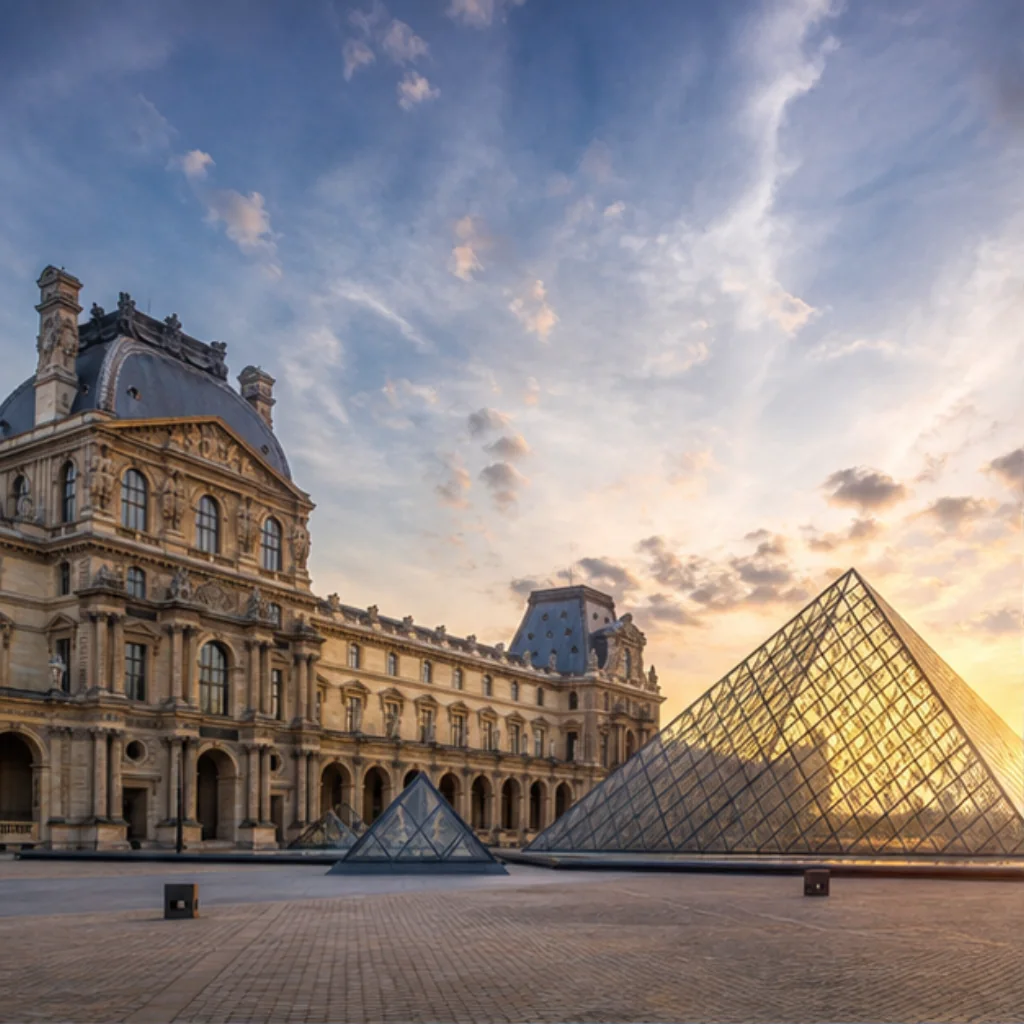
Louvre and Arc de Triomphe photos can belong in the same Paris album without belonging in the same hurried outing. The Louvre invites you to look at glass, palace façades, and the art you choose to visit. At the arch, the approach, the monument’s scale, and the memorial beneath it deserve different kinds of attention.
Give each stop its own purpose before putting them on a schedule. You might want a courtyard portrait at one and time under the arch at the other. Or a museum booking and a terrace visit may be the main events. Decide what matters first, then fit photographs around it. This guide offers composition and planning choices, not a measured connection between the two places.
Keep the Louvre courtyard and the galleries as separate plans
Start by deciding whether you are visiting the museum, photographing the exterior, or doing both. A courtyard portrait and a gallery visit require different amounts of attention. If you have a museum booking, protect its arrival arrangements and the time you want with the collection instead of allowing repeated pictures outside to consume them.
For the courtyard scene, look at the relationship between the pyramid and the palace. Choose an edge of the glass or a section of façade to organize the frame. You can make one wide photograph that explains the setting, then move to a closer portrait with a simpler background. The second picture does not need to repeat the first at a slightly different distance.
If your group wants different things, agree on a meeting point and a modest amount of photo time within your actual access arrangements. Someone who wants to linger over a painting may not want a long portrait session first. Making that choice explicit is more useful than adding another saved photo position to the day’s list.
Use the pyramid’s lines without turning the portrait into a puzzle
Strong geometry can help a portrait, but it can also compete with the person. At the Louvre Museum Landmark, begin with the expression and the space around the face. Then check whether an edge of the pyramid cuts through the head or whether a palace detail creates an awkward shape behind a shoulder.
A small change in framing may solve the problem. You can move the camera, change the crop, or choose a different section of background from an appropriate pedestrian position. There is no need to climb onto a ledge or block an entrance to align every line. An off-center person and a partial view of the glass can still make the location clear.
Keep a photograph of the scene as you encountered it, including other visitors if they are part of the view. The Unlocked Experience called Empty Cour Napoléon is a generated interpretation, not a forecast of an empty courtyard. Similarly, Pyramid Reflections describes a creative direction; it does not establish that a particular reflection or camera position will be available on your day.
Let the art visit determine the camera rules
Inside the museum, follow the Louvre’s official rules. They allow photographs and video for personal use in the permanent collections, with no flash, lighting, or selfie sticks. Temporary exhibitions can restrict photography of certain works. Read the instructions where you are instead of carrying one general assumption through every room.
Choose a few works or details that you want to remember, then spend time looking before reaching for the camera. A photograph can preserve a composition or a label for later reference, but making it should not prevent you from seeing the work itself. Leave space for other visitors to look, and follow staff directions about where you may stop.
Venue admission and photography arrangements belong to the museum. An app Experience neither supplies a ticket nor changes those conditions. If the galleries are the reason for your visit, let the final set of photographs be small enough that you remember more than moving from one camera position to the next.
Approach the arch as a monument and a memorial
For the Arc de Triomphe, resolve the approach before thinking about symmetry. The official visitor information directs pedestrians through the Passage du Souvenir. Use that approach and current directions; do not cross the traffic circle to reach a photograph or an app unlock. Check the same page for access changes and ceremony arrangements before planning an ascent.
A view from across an avenue and a visit beneath the arch are separate positions. Choose a permitted place where stopping leaves pedestrians room to pass. Let the arch sit to one side of a portrait if that works from your position. A perfectly centered composition is not a reason to step into the roadway, and a generated preview should never be treated as an instruction to reproduce its camera location.
Under the arch, give the Tomb of the Unknown Soldier and any ceremony your attention. Follow barriers and staff directions, and put the phone away when a quiet moment is more appropriate. Decide whether a picture of architectural detail or the wider setting expresses what you want to remember better than a posed portrait beside the memorial.
Keep each visit and each unlock distinct
The Paris collection includes both Landmarks, but one successful location check does not unlock the other. At each place, choose Unlock in the app while inside its supported area and confirm the result before leaving. If access restrictions prevent reaching that area, respect them and return when a permitted visit is possible. Photos taken elsewhere cannot complete the missing check.
After unlocking, the Louvre offers Empty Cour Napoléon, Pyramid Reflections, and Palace Noir. The arch offers Étoile Symmetry, Champs-Élysées Gold, and Eternal Flame Noir. These are creative directions for generated Memories. They provide no private courtyard, terrace admission, ceremony access, or reserved photo position. Your first GPS unlock grants one welcome credit once per account, rather than another credit at every stop.
You can choose an Experience and create your private Memory later, when there is time to select reference photos. Keep the original camera images for the actual conditions and the generated Memory as a personal interpretation of a verified visit. Giving each place its own attention leaves room for both kinds of keepsake without making the day revolve around producing them.
Useful details
Frequently asked questions
Does this guide provide a walking itinerary between the two landmarks?
No. It offers two photo plans that can fit on different days. Choose the connection using a current map and your bookings, mobility needs, and available time rather than treating the stops as a timed route.
Can I take photographs inside the Louvre?
The Louvre permits personal photography in its permanent collections without flash, lighting, or selfie sticks. Temporary exhibitions can restrict photography of certain works. Check the current official rules and follow instructions in the galleries.
How do I reach the Arc de Triomphe safely?
Follow the official approach through the Passage du Souvenir and current visitor directions. Do not cross the traffic circle for a photograph or an unlock. Check the venue’s access information for closures and ceremony arrangements.
Source notes
Sources
This article was prepared with editorial automation using the source pack below.
- Paris Landmarks and ExperiencesUnlocked
- Louvre museum rulesMusée du Louvre
- Arc de Triomphe practical visitor informationCentre des monuments nationaux