Chongqing is China’s vertical city: buildings stacked on hills, rivers meeting below, neon everywhere after dark. This guide covers each supported Landmark with composition advice and the practical details — timing, floors, crowds — that make the photos work.
Chongqing’s signature look is after dark, when Hongyadong glows and the skyline doubles in the rivers. Plan daytime for Ciqikou and the courtyards, and save your best energy for the evening views.
02
Learn the vertical map
Streets pass through buildings at multiple levels, and your map’s “flat” route may include a ten-floor change. Give yourself extra time between spots and enjoy the fact that getting lost is the tour.
03
Expect crowds at the classics
Hongyadong and Liziba draw serious evening crowds. Arrive before the lights come on, find your angle early, and let the scene fill in around you.
The collection
7 photo spots in Chongqing.
The Chongqing Landmarks with dedicated guides, each with the composition advice from its full page. Visit in person to unlock its badge in your free Passport.
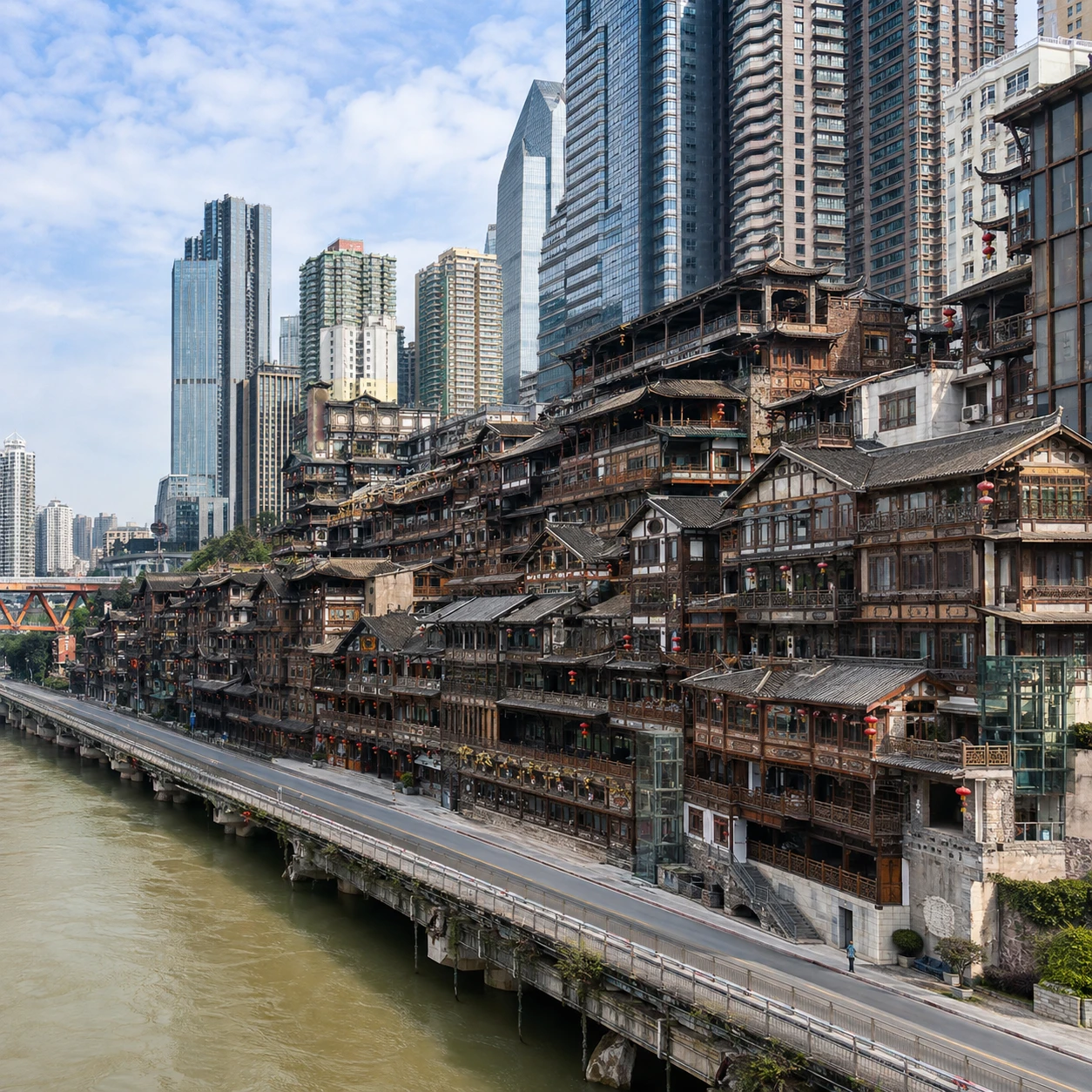
Hongyadong gives a photograph several levels to work with: tiled eaves, timber galleries, river, and city. Choose one relationship for the wide frame and a simpler backdrop for your portrait.
Start with a broad view that explains how the galleries rise above the riverfront. For a personal portrait, choose a smaller section of the architecture so your face stays readable.
Check the pedestrian approach and the level you need before following a saved viewpoint. In Chongqing, a nearby point on a map can sit above or below the path you are using.
If the lights are on, compare the bright eaves with the light on the person. Keep one picture of the illuminated setting and another that preserves the expression; neither needs to solve both perfectly.
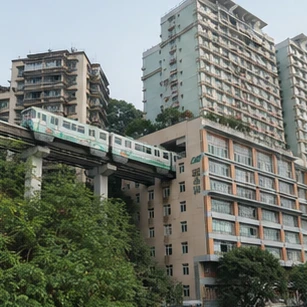
The train is only part of the picture. Leave enough of the building in view to explain Liziba, then choose how you want to appear in the scene without turning every passing train into another attempt.
Use the designated viewing area and current pedestrian directions. Frame the opening in the building before waiting for a train, so the movement has a clear place to enter the picture.
Make a scene photograph or short clip first, then a portrait. If a helper is taking the portrait, show them the framing and ask for a short set rather than trying to direct a pose and a moving train at once.
Keep paths clear and respect the surrounding homes and transit spaces. A photograph from another overlook or a passing train is separate from completing the supported-area location check.
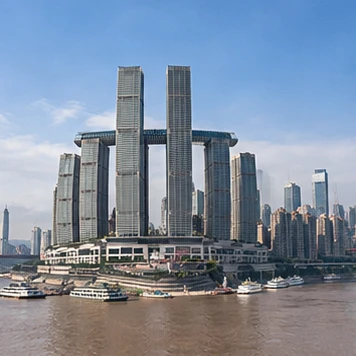
At Chaotianmen, the rivers provide the space and the skyline supplies the scale. Keep one photograph for the confluence and another for the person who came to see it.
Choose a permitted position in the square or visitor area and decide whether the water or skyline should dominate. An open foreground can explain the confluence without fitting every tower into the photograph.
Bring the person closer for the portrait and check that a railing or skyline edge does not cut awkwardly through the face. You can change the crop without moving beyond a barrier.
Plan your pedestrian approach to Chaotianmen Square specifically. The metro station, bridge, waterfront buildings, and distant views are different places despite sharing the Chaotianmen name.
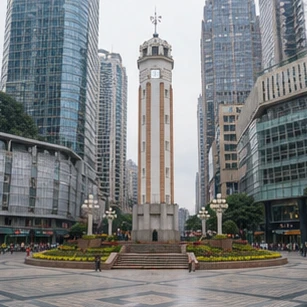
Jiefangbei is a study in contrast: the stone monument below, the glowing towers above, and the pedestrian crowds between. Decide early whether the story is the monument or the skyline.
The monument photographs best from across the pedestrian square, with the towers rising behind it. A close frame keeps the clock detail but loses the scale.
The streets around the monument are busy at every level. Keep walkways clear, follow the crossing signals, and let the crowd flow carry you to a new angle instead of standing still.
Evening is when Jiefangbei earns its nickname: the screens turn the streets into a canyon of light. Compare the lit scene with the person before committing to one frame.
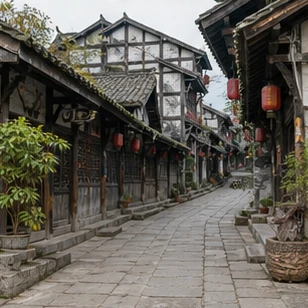
Ciqikou runs uphill from the river: stone lanes, red lanterns, and working teahouses. The photograph works when the lanes read as lived-in, not emptied for the camera.
The main street is the busiest lane; the side alleys keep the old texture with a fraction of the visitors. Turn uphill early and let the crowd thin behind you.
Teahouses and shops operate at street level—keep doorways and seating clear, and ask before photographing staff or guests at close range.
Late afternoon lanterns and morning quiet are the two best hours; midday weekends are the busiest stretch of the whole collection.
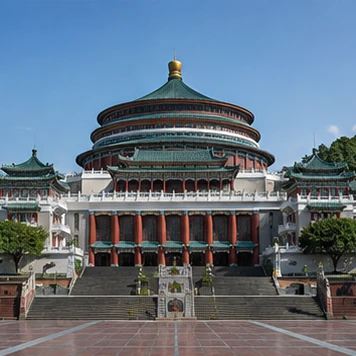
The Great Hall is Chongqing at its most formal: a green-tiled dome, red columns, and a broad square built for exactly the kind of photograph you are imagining.
From the square’s far side, the dome sits comfortably above a standing portrait; from the steps, the columns take over the frame entirely.
The square hosts ceremonies and seasonal events—follow barriers and staff guidance, and keep your staging clear of the central axis when it is busy.
Late afternoon warms the pale stone; the floodlit dome after dark is a second, completely different photograph.
Illustrative catalog artwork. The visit is yours to make.
Plan the day
Chongqing photo spot questions.
Are all of these Chongqing photo spots free to visit?+
Yes — the exteriors and public areas of all seven Landmarks, including Hongyadong’s towers, the Liziba viewing platform, and the riversides at Chaotianmen, are free to photograph. Museums inside some sites may charge separately. Unlocked’s Landmark unlock is always free.
Where is the best view of Hongyadong?+
Across the river from the towers, and from the bridges and walkways nearby, where the full eleven floors reflect in the water. The street-level view is impressive but the across-the-river angle is the famous one.
How do I photograph the train at Liziba?+
The monorail passes through a residential building roughly every few minutes. Stand in the viewing area below, use a wider lens than you think, and film at least one full pass — stills and video both work here.
Turn the photo into a keepsake
Collect the badge. Keep Chongqing in your Passport.