Cairo architecture and market photos become more personal when you stop asking every place to provide the same portrait. An arcade gives you rhythm, a city view gives you distance, and a market lane gives you movement and small details. Choose two settings that interest you, then leave enough time to experience each before adding more stops.
The six Cairo Landmarks below are options for different outings. They are not a measured walking circuit, and their visitor arrangements are independent. Use a current map to decide the connections and keep Giza as its own excursion. A useful plan includes what you are willing to leave for another day.
Choose the Citadel for its setting as well as its buildings
The Ministry’s Citadel page describes the fortress’s position on the Muqattam Hills and the monuments within it, including Muhammad Ali Mosque. At Cairo Citadel, decide whether a building or a wider city view should lead your photograph. Giving them separate frames can make both easier to understand.
For a portrait with architecture, look at the space around the head before including more domes or minarets. For a city view, leave a clear strip of skyline and let the person occupy a smaller part of the setting. If distant detail is soft on the day, choose a nearer surface or shape rather than waiting for the same photograph to become clearer.
Arrange entry separately and follow the directions for each visitor area. A complex can contain different kinds of space with different expectations. Do not assume that access to one courtyard permits every interior or rooftop. The Experience Terrace Horizon describes a generated creative direction; it is not a reservation or a route to a restricted position.
Give the two mosque visits different photographic jobs
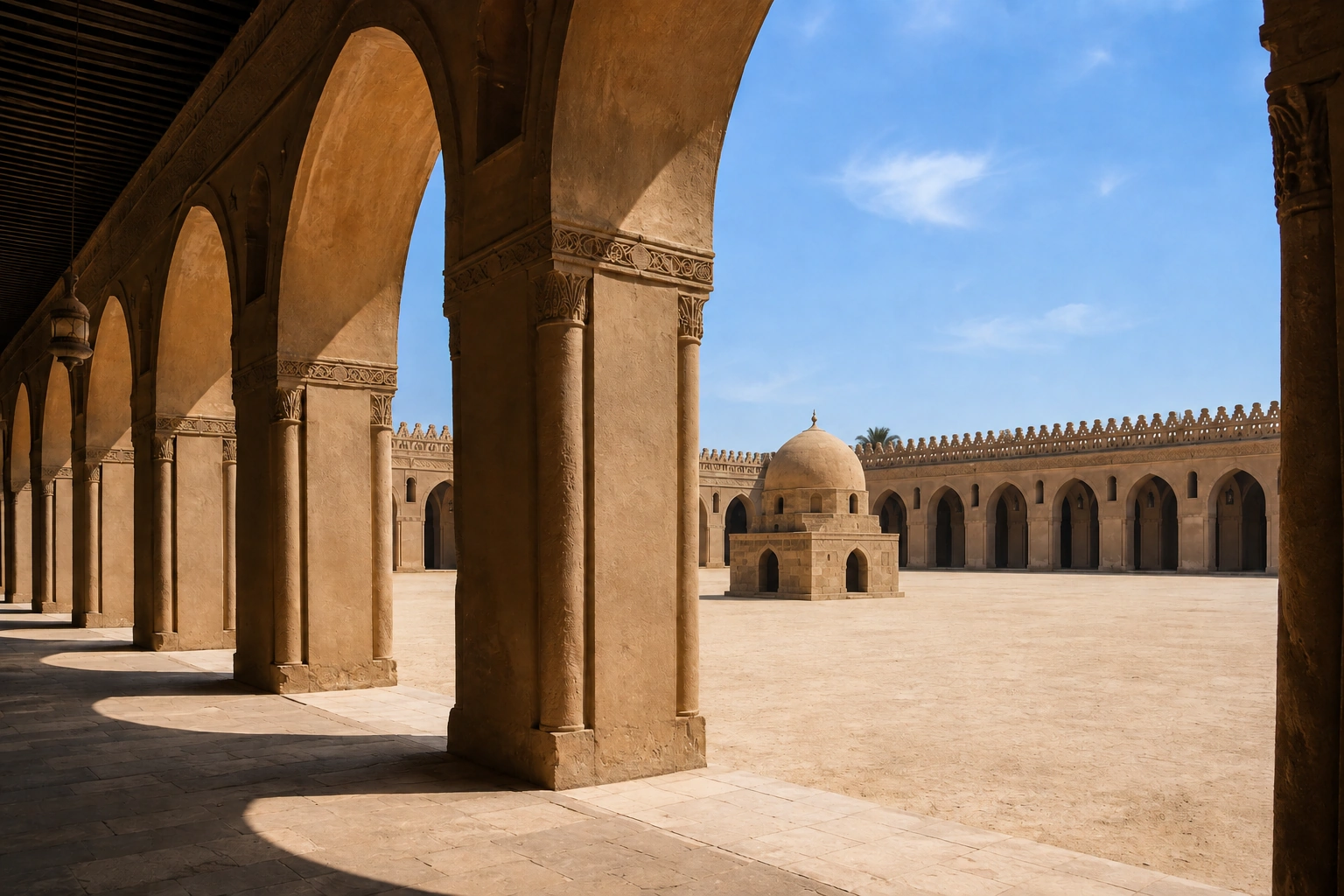
At Ibn Tulun Mosque, repeating arches can guide the eye through a portrait. From a permitted position, keep the camera reasonably level and leave a gap around the person so the arcade remains readable. Make a separate detail photograph if the brickwork or a particular shadow catches your attention. A ground-level view can be complete without a minaret climb.
At Sultan Hassan Mosque, a taller opening or section of stone can give the frame a different scale. Choose between showing the space around a person and making a closer expression the main subject. Confirm the building you are visiting: Sultan Hassan and neighboring Al-Rifa’i are different monuments, while Muhammad Ali Mosque belongs to the Citadel setting.
Follow current guidance about dress, footwear, access, and photography at each site. Ask staff where visitors may pause and keep worshippers out of close portraits. If a space is in use for prayer or a doorway needs to remain clear, put the camera away or choose another permitted view. The visit has a purpose beyond your picture, and there is no need to arrange a pose in every room.
Let the market interaction come before the picture
Khan el-Khalili is a working market. Begin by looking for a place to stand that leaves the lane open. A stall, doorway, or group of lanterns might give a portrait enough context without filling the background with every object on display. Choose one clear detail and let the rest of the scene fall away.
Ask the shopkeeper before making their stall or merchandise the main backdrop, and ask a person directly before making a close portrait of them. If they decline, choose another subject. Taking time for that exchange can make the photograph part of an ordinary visit rather than an interruption. If a paid service is proposed, understand and agree its terms before proceeding.
Bright lanterns and polished surfaces can compete with a face. Check a short set of frames and move the camera slightly if a highlight dominates. Let a companion look at an object or along the lane if that feels more natural than a fixed pose. Keep the image that recalls the encounter, and leave room for shoppers to continue their day.
Choose a garden view or a tower portrait
Al-Azhar Park offers a change of setting. Choose either a garden path or a distant city view as the main line in the picture. Putting both in equal competition can make a small phone image busy. Stay on designated paths, keep out of planted beds and water features, and use the visitor space available on the day.
Cairo Tower asks for another framing decision. A ground-level portrait can show the tower as a structure, while an observation-deck visit is a separate choice about the view from it. Keep the tower’s crown clear of the person’s head, and leave enough sky above the top. Do not confuse a distant riverbank photograph with arrival at the supported tower area.
These are alternatives for the time you have, not an instruction to fit both into the afternoon. Check each venue’s current entry and photography arrangements. A closer portrait with a recognizable piece of background can be enough when a wider position is unavailable. Keep one scene image as well, then give yourself time to enjoy the change of pace.
Bring the photographs together after the visits
Review a small selection across places instead of judging each frame against a saved travel photograph. One courtyard image, one market detail, and one open view can show more of your day than a series of identical poses. Keep the differences in scale and atmosphere; they help you remember why the stops felt distinct.
The Cairo & Giza collection requires a separate successful Unlock at each supported Landmark. Open the correct place in the app, complete the current location check inside its supported area, and confirm success before leaving. Al-Azhar Park is distinct from Al-Azhar Mosque, and a nearby market visit does not unlock either a park or a mosque automatically. Respect barriers if access prevents reaching the supported area.
After unlocking, choose a curated Experience and create a private Memory with your reference photos when you have time. Arcade Rhythm, Lantern Warmth, Garden Skyline, and Lotus Lines belong to different Landmarks and describe generated interpretations. Preserve the real camera photographs alongside them and identify generated images when sharing. For the separate plateau excursion, the Giza personal photo guide focuses on portraits against a much larger landscape.
Useful details
Frequently asked questions
Does this guide cover all six Cairo stops as one walking route?
No. It offers choices across different settings, not a timed itinerary. Select the visits you want using a current map, your available time, mobility needs, and venue arrangements; Giza belongs to a separate excursion.
Does a mosque Experience change visitor photography rules?
No. Follow current staff guidance about access, dress, footwear, prayer, and photography. The app offers generated Memories after a verified visit; it grants no interior access, minaret climb, or permission to photograph worshippers.
Are Al-Azhar Park and Al-Azhar Mosque the same Landmark?
No. The supported Landmark is Al-Azhar Park. A visit to the mosque or a nearby market does not replace the park’s location check; open the correct place in Unlocked and confirm its unlock during the visit.
Source notes
Sources
This article was prepared with editorial automation using the source pack below.
- Cairo & Giza Landmarks and ExperiencesUnlocked
- Cairo Citadel setting and monumentsEgyptian Ministry of Tourism and Antiquities
- Ahmad Ibn Tulun MosqueEgyptian Ministry of Tourism and Antiquities
- Mosque and Madrasa of Sultan HasanEgyptian Ministry of Tourism and Antiquities
- Khan el-KhaliliCairo Governorate
- Cairo TowerCairo Governorate
- Al-Azhar Park visitor informationAl-Azhar Park