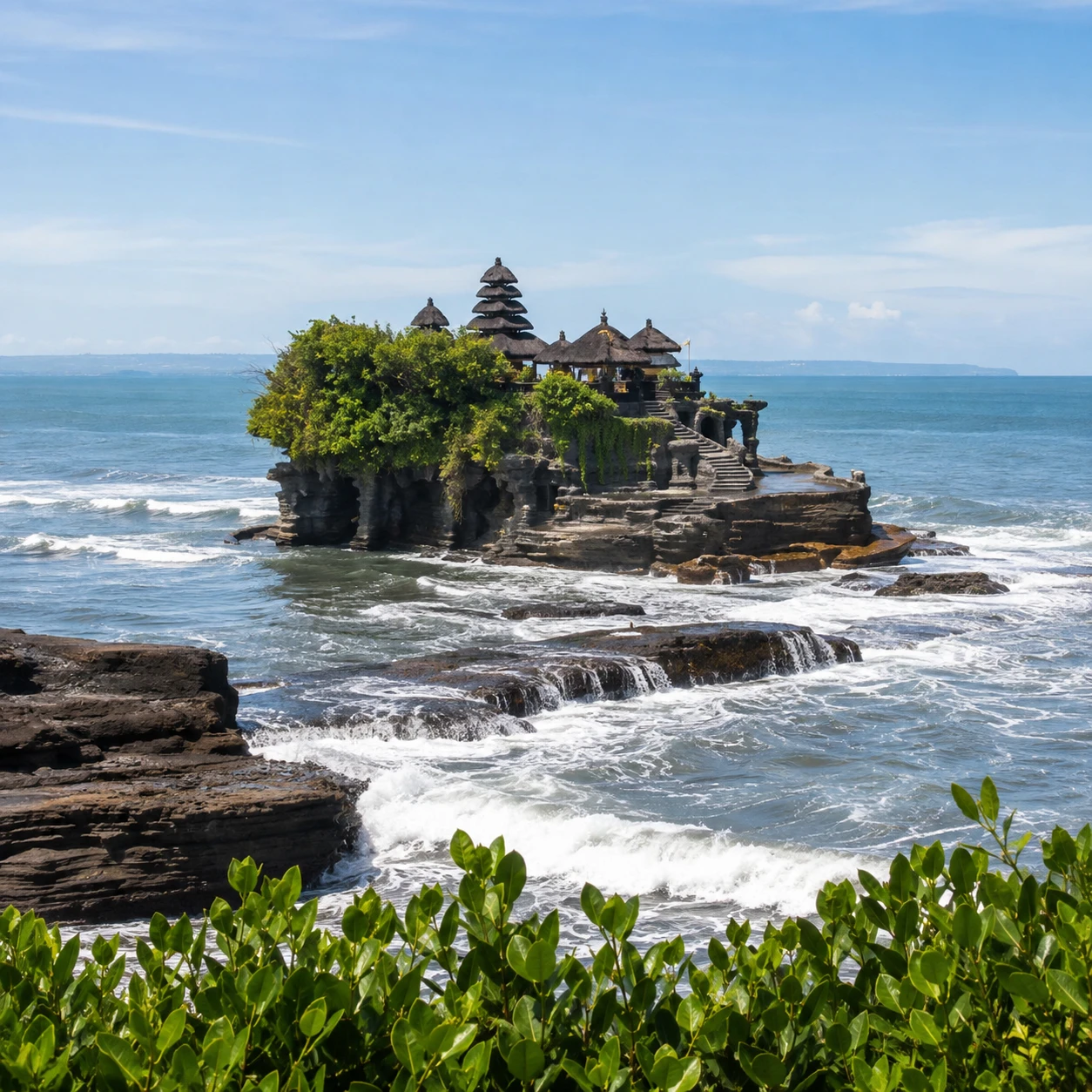
Bali temple photos can describe very different visits. At Tanah Lot, a rocky outcrop meets the open ocean. At Ulun Danu Beratan, tiered roofs sit beside a highland lake. Water belongs in both compositions, but the shape of the background, the journey, and the visitor setting are different.
Treat these as two places you may choose for your trip, each with its own travel and entry arrangements. Bali is an island destination, so two entries in the same app collection are not evidence of a short connection. This guide helps you decide what to photograph at each; it is not a timed itinerary or a report of conditions observed on your date.
Choose the outing before choosing the light
Start with where you are staying, the place you want to visit, and how you will get back. Put the full destination name into your map and check current local transport advice. For the lake temple, that name is Ulun Danu Beratan, beside Lake Beratan in Bedugul. Do not substitute a similarly named temple when arranging the journey.
Indonesia Travel places Tanah Lot in Tabanan, while its Ulun Danu Beratan page describes the Bedugul highland setting. Use those distinct places as the basis of the plan. Decide whether they fit separate days before adding a desired sunset or a morning photograph.
A light preference should remain flexible enough to protect the visit. If a particular time makes transport or the return journey awkward, choose another time or another day. You can make a meaningful picture without asking the weather, water, and schedule to reproduce an image you saved before the trip.
Let Tanah Lot’s outline carry the coastal picture
At Tanah Lot, try one scene photograph that leaves space around the outcrop. Look at the relationship between the temple’s outline and the ocean before deciding how much sky to include. Too tight a crop may remove the coastal setting that makes the shape distinctive.
For the portrait, bring the person closer to the camera from a permitted visitor position. Keep the outline recognizable in the background and check whether the horizon passes through the face. A modest change in camera height or framing can separate those elements without asking the person to move toward the water.
When the sky is much brighter than the foreground, choose a purpose for each picture. A silhouette can emphasize shape; a closer portrait can preserve an expression. Take them separately if necessary. Repeating the same frame without choosing between those goals can leave you with many pictures that satisfy neither.
Let local access determine where you stand
Plan your coastal photograph from the visitor space available on the day. Follow barriers and staff directions, and check current entry arrangements. A photograph showing exposed rock or a dry approach does not establish that the same position is safe, accessible, or permitted now.
Give the temple’s religious setting room in your plans. Follow local visitor and dress guidance, keep access routes clear, and avoid arranging poses that intrude on worship. If an area is restricted or a ceremony changes the space available, move the photograph to a permitted position or put the camera away.
An app Experience does not resolve any of those arrangements. Sea Temple Sunset describes a generated creative direction; it supplies no admission, tide information, or permission to cross toward the rock. Choose your physical position from the actual conditions and visitor directions, then decide which picture works there.
Change the composition beside Lake Beratan
At Ulun Danu Beratan, look at the tiered roofs and the surrounding water before centering a person in the frame. Make one photograph that explains the relationship between architecture, lake, and background. Then simplify the portrait so the person remains readable among those shapes.
If a reflection is visible, decide whether it deserves space in the picture. It might become the main visual relationship, or a small detail below the roofs. If the water is rippled or the available position does not show the reflection you imagined, use the roof layers and background instead. The visit does not become incomplete because a reflection is absent.
The same applies to mist. Work with the visibility you have, rather than treating a soft highland atmosphere as a condition the place owes you. In Unlocked, Highland Mist and Lake Stillness are generated Experience names. They do not forecast the air or water during your trip, or require you to wait for either condition before unlocking.
Keep the portrait considerate and brief
Before handing over a phone, show a companion the composition and identify one thing to preserve. An illustrative coastal request is: “Keep the temple outline beside me and leave some ocean visible.” At the lake, it might be: “Keep those roof layers above my shoulder and move closer for my face.” A specific request gives the helper a manageable task.
Take a short set and check the essential details. If your expression is clear and the place is recognizable, you may already have the picture you need. Move out of a shared stopping point before reviewing every frame, and give other visitors room to see the view or continue along the path.
Choose the final images together afterward. The coastal picture might have a broad sky and a dark outline, while the lake portrait might be closer and more detailed. Keeping that difference helps the album recall two separate visits instead of reducing both places to the same pose beside water.
Keep each verified visit for later
The Bali collection contains seven separate Landmarks. At each one, open the app and choose Unlock inside its supported area, only where visitor access is permitted. Confirm success before leaving. If a restriction prevents reaching the supported area, respect it and return when a permitted visit is possible.
Tanah Lot offers Sea Temple Sunset, Ocean Morning, and Coastal Silhouette. Ulun Danu Beratan offers Lake Stillness, Highland Mist, and Meru Reflections. Once a Landmark is unlocked, you can choose an Experience and create a private Memory later from your reference photos. One temple’s unlock does not unlock the other, and the welcome credit is granted once per account on the first GPS unlock.
Keep your camera photographs for the scenes you actually encountered, and identify generated Memories as creative interpretations when sharing. For an outing organized around walking rather than a temple visit, the Campuhan Ridge Walk photo guide offers a different way to build a small set of personal pictures in Ubud.
Useful details
Frequently asked questions
Can I treat these temples as a short walk between app Landmarks?
No. Bali is an island collection with Landmarks in different areas. Check the complete journey and return arrangements for each place before deciding whether they belong on the same day.
Does the app provide temple entry or ceremony access?
No. Follow each venue’s current entry, dress, and visitor guidance. An Unlocked Experience creates a generated Memory after a verified visit and changes none of the temple’s access arrangements.
Do I need sunset, mist, or still water to unlock?
No. The location check verifies your presence in the supported area, not the weather. Experience names describe generated creative directions you may choose after a successful visit.
Source notes
Sources
This article was prepared with editorial automation using the source pack below.
- Bali Landmarks and ExperiencesUnlocked
- Tanah Lot sea templeIndonesia Ministry of Tourism
- Ulun Danu Beratan and its highland lake settingIndonesia Ministry of Tourism