Both apps answer “where have I been?”—and then stop agreeing. Fog of World turns your movement into a fog-of-war map: everywhere you walk, drive, or train, on any street in any country, slowly clears. Unlocked records something narrower on purpose: verified arrivals at named Landmarks, each of which unlocks curated Experiences you can later turn into photographic Memories.
If you are deciding today, the short version is this. If you want the biggest possible picture of everywhere you have physically been since installing it, Fog of World is that product, and its one-time price buys a well-made one. If you want a record where each entry is a place you deliberately arrived at, with a date, a badge, and eventually an image worth keeping, that is what Unlocked is built for. And because Unlocked is free to download and unlocking costs nothing, keeping both is a reasonable plan many travelers arrive at.
What you are choosing between
| Fog of World | Unlocked | |
|---|---|---|
| What gets recorded | Every movement, everywhere, since install | Verified arrivals at Landmarks in 30 supported cities |
| How it is recorded | Continuous background GPS; fog clears as you move | On-demand presence check when you are at a Landmark |
| Backfill of past travel | Yes, via imported GPX tracks | No—unlocks require live presence |
| What an entry becomes | Cleared fog on a map; badges and a passport view | A dated unlock, permanently unlocked Experiences, and Memories |
| Photos and memories | None—it is a coverage map | Generated photo Memories from your unlocked Experiences |
| Price model | Paid app, about $29.99 once (as of this writing) | Free download; optional credits for Memories; no subscription |
| Platforms | iOS and Android | iOS and Android |
Fog of World records everywhere. Unlocked records arrival.
Fog of World’s strength is completeness. It does not care whether you are crossing Tokyo or walking to your own corner shop—movement is movement, and fog clears the same way. Over years, that produces a genuinely personal artifact: the shape of your actual life on a map. It can also import GPX tracks from other services, so history you recorded elsewhere can feed the fog. Nothing about that is a small feature; it is the whole product, and it is well executed.
The trade-off is that coverage is undiscriminating. A cleared square kilometer looks identical whether it contains the Eiffel Tower or a ring road. The map cannot tell you which landmarks you stood in front of, when, or what that day was.
Unlocked inverts the priority. It maintains a curated catalog—30 cities so far, from Barcelona to Baku, each with a small set of named Landmarks—and your record grows only when you actually reach one. Each unlock is stamped with its date and counted toward that city’s progress in My World. The map is smaller by design, but every pin on it is a statement: I was here, on this date, and the app checked.
If your travel identity is “how much of the world’s surface have I crossed,” Fog of World is the honest tool for it. If it is “which significant places have I actually reached,” that is Unlocked’s question.
One watches your GPS all day. The other checks when you arrive.
To clear fog, Fog of World needs location access continuously, in the background, all day. That is inherent to the product, not a flaw—and it is also why the app processes and stores your tracks on the device, with optional sync through services like iCloud or Dropbox. People who love it accept the battery cost the way runners accept a sports watch.
Unlocked takes the opposite approach to location. There is no ambient tracking. Location is read when you are standing at a Landmark to verify presence—timestamp, coordinates, reported accuracy, distance, and radius are all checked, with rate limits against replayed or scripted attempts. Walk away, and the app has no interest in where you go next.
For privacy, the two postures are different rather than ranked. Fog of World keeps everything on your device. Unlocked verifies presence server-side because the value of an unlock depends on it being checked—then holds the personal side of the product to a strict line: reference photos are private content, Unlocked performs no facial recognition or biometric comparison, and you can delete individual Memories or your entire account. The Privacy Policy spells out the details.
What each one gives you at the landmark
This is where the products feel most different in the hand.
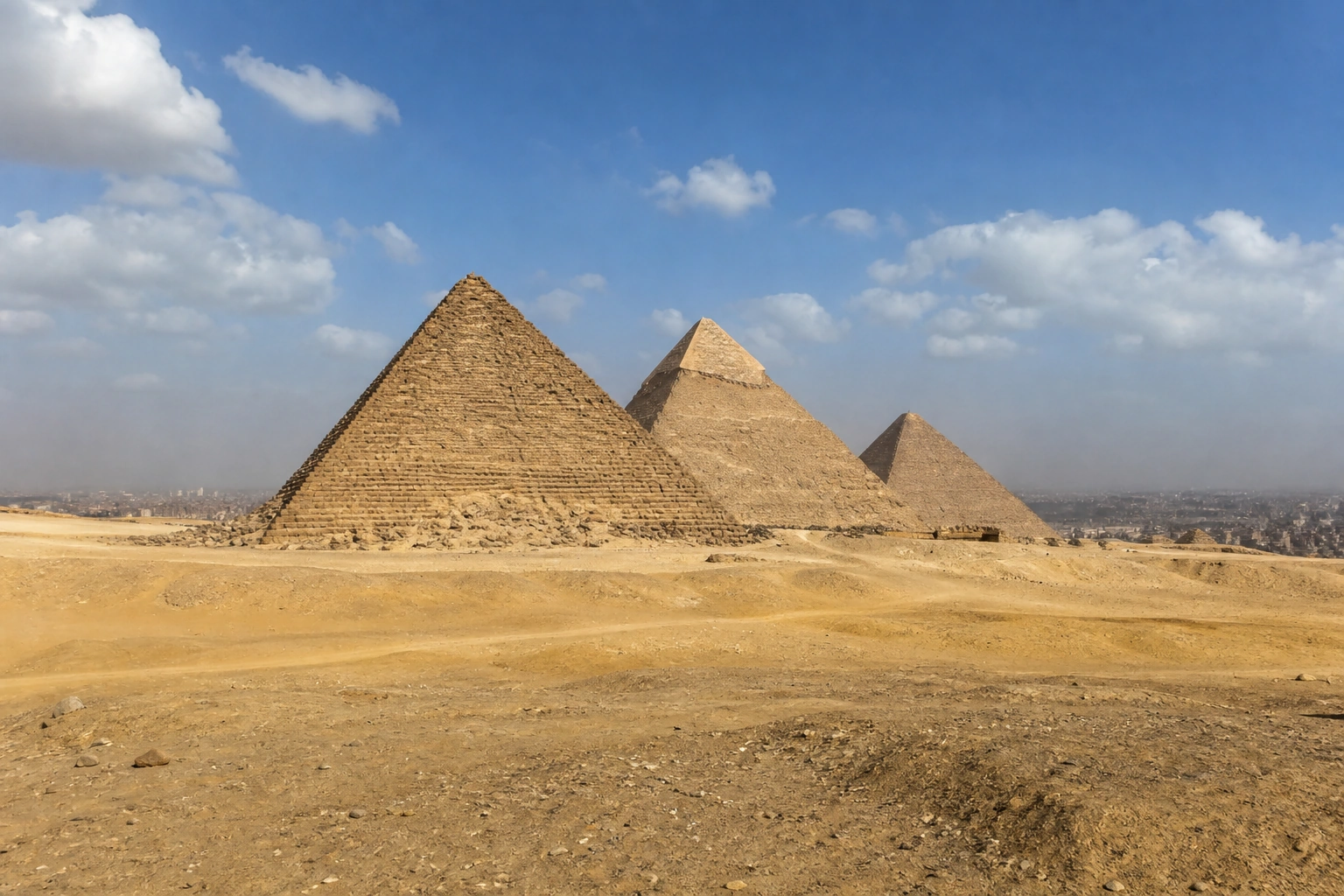
At the Giza Pyramids, Fog of World gives you a satisfying patch of cleared fog and, sometimes, a badge. It is the same reward the app gives for any cleared ground anywhere.
Standing at the Pyramids with Unlocked, the arrival itself is the event: the Landmark unlocks, your date is recorded, and its curated Experiences—editorial presets with names like Empty Park and Golden Hour—become permanently available. That second part matters more than it sounds. You do not have to fight the crowds or the light on the day you arrive. You can unlock now and create the Memory from home next week, once the dust has settled. The result is a generated image of you at the site under conditions no tourist camera roll achieves, clearly disclosed as generative, kept private unless you choose to share it.
A coverage map cannot produce anything like that, and does not try to. For a longer look at this category of product, see how location-based travel apps reward arrival.
Which should you install?
Install Fog of World if:
- you want one map of everywhere you have physically been, not a curated selection;
- you have GPX history from other trackers you want to consolidate;
- you are comfortable paying once up front and leaving background location on.
Install Unlocked if:
- your record should be made of deliberate arrivals at significant places, with dates;
- you want the option of photographic Memories from places you verified you stood;
- you prefer an app that only reads location at the moment of an unlock;
- you want to start free: downloading, unlocking, badges, and sharing never cost anything.
And honestly: the two do not conflict. Fog of World running quietly in the background plus Unlocked opened at each landmark is a combination that costs nothing extra after Fog of World’s purchase price.
Your first unlock takes about ten minutes
- Install Unlocked free on the App Store or Google Play.
- Open Explore and pick a Landmark near you—thirty cities are supported, and the list grows.
- Walk there. The presence check runs; the Landmark unlocks with its date.
- Your first GPS-verified unlock includes a welcome credit, so you can create your first Memory before spending anything. Every Memory after that shows its credit cost before you create it—no subscription, ever.
If that flow matches what you wanted from a travel record today, start with Unlocked, and let Fog of World cover the rest of the map. For a related angle on this decision, read travel photo map vs digital passport.
Product names are the property of their respective owners; features and prices are as described by each product as of publication.
Useful details
Frequently asked questions
Is Unlocked cheaper than Fog of World?
Unlocked is free to download, and exploring, unlocking Landmarks, collecting badges, and sharing your Passport never require payment. Fog of World is a paid app (listed around $29.99 as of this writing). In Unlocked, only optional photo Memories use credits, and your first GPS-verified unlock includes a welcome credit for your first Memory.
Can I import my Fog of World history into Unlocked?
No. Fog of World clears fog from recorded movement, including imported GPX tracks, but that data cannot become Unlocked Landmarks. Unlocked unlocks only from live, checked presence at a landmark, so past trips cannot be backfilled.
Does Unlocked track my location all day like Fog of World?
No. Fog of World depends on continuous background location tracking to clear fog. Unlocked checks your presence when you are at a landmark: timestamp, coordinates, reported accuracy, distance, and radius are validated at that moment. There is no all-day tracking loop.
Source notes
Sources
- Fog of World official siteOllix
- Fog of World on Google PlayGoogle Play
- Unlocked product overviewUnlocked
- Unlocked Privacy PolicyUnlocked