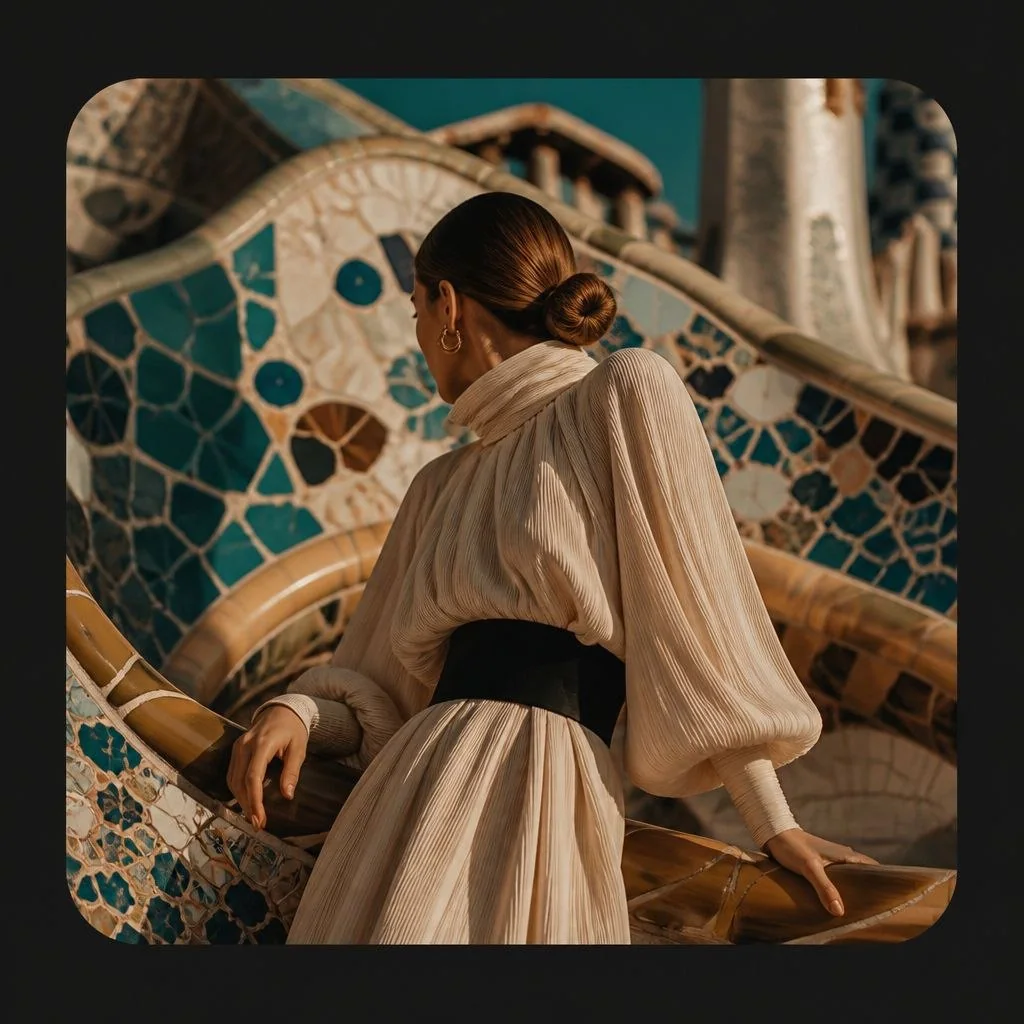
Reference photos for AI travel memories give the creative process a visual reference for you, rather than only a destination and a photographic style. In Unlocked, that personal input sits alongside a selected Landmark and curated Experience to help create a Memory. It does not guarantee an exact likeness or establish your identity.
Before providing an image, ask a practical question alongside the creative one: what permission am I giving, where will this photo go, and how can I remove it later? Those answers matter as much as the intended result.
How Reference Photos Personalize a Travel Memory
A reference photo supplies personal visual context; the Experience supplies the photographic direction. These are different contributions to the finished Memory.
Unlocked’s curated Experiences include editorial choices such as Empty Park, Golden Hour, and Gaudí Editorial. You choose an Experience rather than having to write detailed photographic instructions. The reference image helps connect that creative treatment to the person you want depicted.
That is the narrow purpose of an AI photo reference image here: an input for a requested creative result. It should not be confused with a passport photograph, an identity check, or evidence of a particular moment.
The corresponding consent question is: am I comfortable having this image processed for this requested use, and what other uses do the terms permit? Unlocked’s Terms describe a limited licence to handle uploaded content as needed to operate, secure, improve, and provide the service, including creating a requested Memory. Read that scope rather than assuming the permission covers only the finished picture.
Where reference photos for AI travel memories fit in Unlocked
Reference photos personalize the Memory; physical presence establishes the Landmark Unlock. One does not replace the other.
The Unlocked product overview describes a native travel app built around this sequence:
Physical presence → Landmark Unlock → Curated Experience → Memory → My World.
To Unlock a Landmark, a traveler chooses to submit a current location sample within the supported area. The photo is not the proof of that visit. Unlocked’s privacy documentation says it does not perform facial recognition, compare identities, or create biometric embeddings.
After an Unlock, the traveler can create a Memory later, including from home. The Terms qualify continued Unlock availability by the service and account remaining active. My World brings together travel progress, Unlock dates, and generated Memories; Unlocked is not a generic image generator or a public social network.
Creating later gives you time to consider a personalized travel memory without making that decision at the Landmark. Pair that flexibility with a storage question: will my reference remain stored between creations, and can I remove it without deleting my travel history? Unlocked documents reference removal separately from Memory deletion and account deletion.
An approved reference needs permission, not identity certification
An approved reference should be an image you are entitled to upload and use, not an image assumed to have passed an identity test.
For travelers evaluating any app, approval has two practical parts. First, you need the necessary rights to the photograph and permission from the person depicted. Second, you need to understand and accept the processing involved in creating the image. Possessing a photograph is not, by itself, the same as having every necessary permission.
The Unlocked Terms and Conditions require users to own their uploaded content or have all required permissions. They prohibit uploading someone’s image without permission and content involving a minor without lawful authority and consent.
A useful travel photo consent check is: does everyone whose image I am submitting understand this use, rather than merely having agreed to be photographed? Choosing a photo of yourself can simplify that discussion, but you should still consider who owns the photograph.
This is general evaluation advice, not a claim that Unlocked certifies consent on your behalf. For the broader distinction between taking, uploading, and sharing a picture, see travel photos and privacy.
Personalization does not promise a faithful reconstruction
An AI travel portrait is a creative interpretation, not a guaranteed reproduction of your appearance or an event.
Unlocked’s Terms explicitly say a Memory may not precisely reproduce a person, place, object, event, or historical detail. Generated content can be imperfect, inaccurate, or visually inconsistent. A reference image does not remove those limitations.
A curated Experience can offer a different visual treatment of a place you visited. That benefit belongs alongside a deletion question: if the result does not feel like me, can I remove it, and what remains afterward? Unlocked allows individual Memories to be deleted after confirmation. Deletion does not revoke the Landmark Unlock or refund spent credits.
There is also a distinction between the visit and the picture. The Unlock relates to physical presence; the generated Memory is not evidence that its depicted scene occurred. Unlocked identifies generative content in the product, and its Terms prohibit harmful deceptive presentation.
Before saving or sharing a result, review it as a creative image rather than treating the reference photo as a promise of accuracy.
Private storage does not mean images never leave Unlocked
A private image can still be transmitted to another company for the creation you request.
According to the Unlocked Privacy Policy, Memory creation sends reference images and any current-look photo to OpenAI. The accompanying information includes the selected Landmark and Experience, visit date and time-of-day context, and optional aesthetic instructions. These inputs support the requested personal and place-based treatment. The corresponding question is: am I comfortable with these images and this context being sent together?
Unlocked documents private storage for references and Memories, with short-lived access links rather than permanent public image addresses. It also says it does not sell face reference images or automatically publish a gallery. These are specific boundaries, not a promise that nobody else processes the images.
Consent deserves a separate check. The documentation describes a “Photo permission” sheet and a recorded permission to share images with OpenAI, withdrawable from the Privacy screen. It also describes a configuration where the sheet is bypassed and first creation records consent implicitly, without overriding an explicit withdrawal. Do not assume a separate confirmation will appear in every flow.
Before proceeding, ask who can access stored images, whether any human review occurs, and what retention applies at OpenAI. The supplied documentation does not settle every access or retention detail.
Deletion has several scopes, so choose the one you mean
Removing a reference, deleting a Memory, and deleting an account are distinct actions.
Unlocked documents controls for deleting one reference, all references, individual Memories, or the entire account. If your aim is to stop keeping the original personal image in the app, look for reference removal rather than assuming that deleting the finished portrait does the same thing.
For an individual Memory, deletion immediately hides it from product reads and removes its private image object, with retries if storage is unavailable. A historical creation record remains for credit accounting and other documented operational purposes. Copies already saved or shared, previously issued access links, backups, and retention by external services have separate limits.
Keeping selected Memories in My World offers a personal record of travel. Pair that benefit with this question: can I remove the image while retaining the visit? Unlocked says deleting the last Memory empties the gallery while retaining earned travel history.
Before your first upload, use the AI travel photo privacy checklist to check permission, recipients, storage duration, access, and deletion separately. If an answer important to you is missing, clarify it before supplying a reference photo.
Useful details
Frequently asked questions
Why does an AI travel photo app need an approved reference image?
A reference image supplies personal visual context for the requested portrait. Approval should mean you have the rights and permission to use the photo and understand how it will be processed—not that the app has verified your identity. Unlocked requires permission to use uploaded content and treats permission to share images for Memory creation as a separate consideration.
Does a reference photo guarantee that a Memory will look exactly like me?
No. Unlocked’s Terms state that generated Memories can be imperfect, inaccurate, or visually inconsistent and may not precisely reproduce a person or place. A reference photo supports personalization; it does not guarantee an exact likeness. A Memory is a creative output, not evidence that the depicted scene occurred.
Does deleting a Memory also delete my reference photos?
Unlocked documents separate controls for removing one reference, all references, individual Memories, or the account. Do not treat Memory deletion as reference deletion. Deleting a Memory also does not remove copies already saved or shared elsewhere, and backups, previously issued links, and external-service retention have separate limits.
Source notes
Sources
This article was prepared with editorial automation using the source pack below.
- Unlocked product overviewUnlocked
- Unlocked Privacy PolicyUnlocked
- Unlocked Terms and ConditionsUnlocked